
Archimedes: Why Ships Float
The secret of buoyancy: why a huge ship floats but a tiny key sinks.
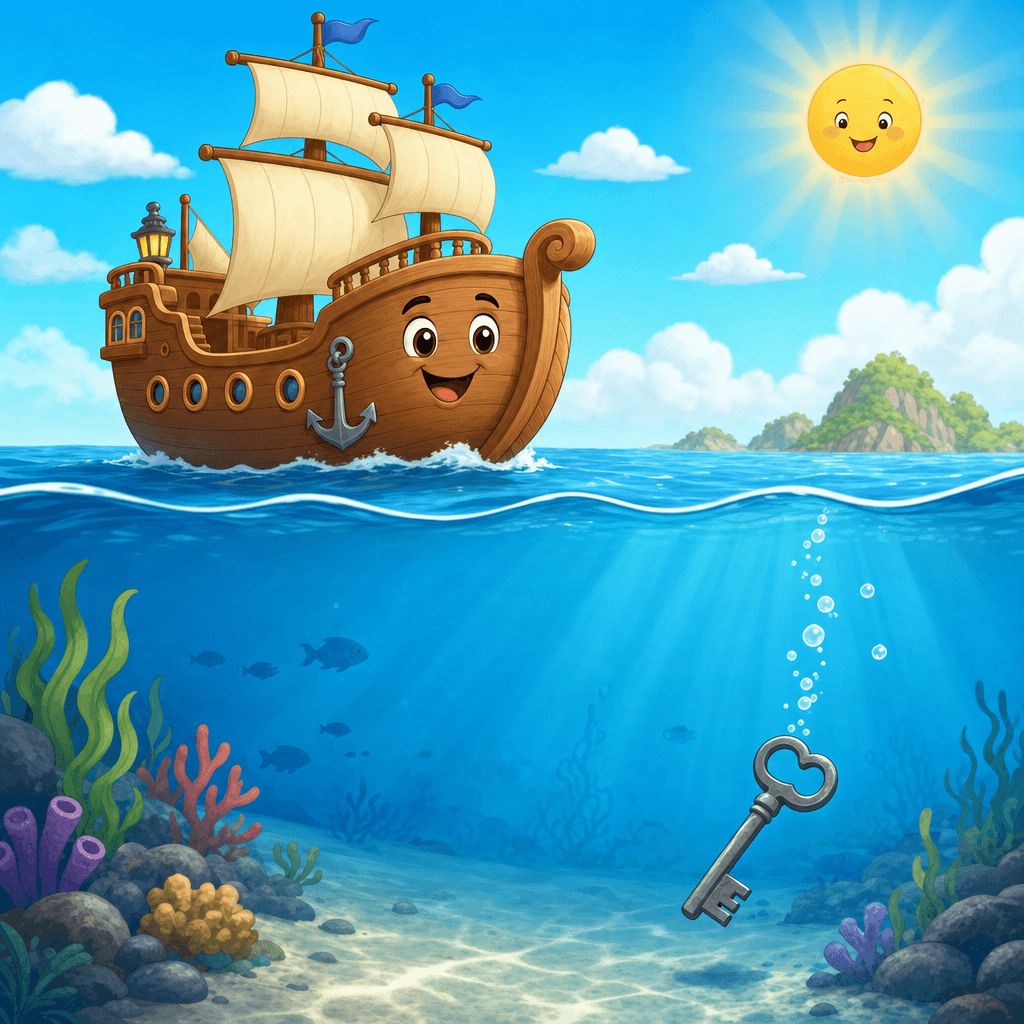
A Floating Mystery
One of the coolest questions in science is also one of the simplest: why does a giant ship float while a tiny coin sinks? The ancient Greek scientist Archimedes helped explain that mystery.
His most famous idea is now called Archimedes’ principle, and it describes buoyancy, the upward push that a fluid gives to an object. If you understand buoyancy, you can understand boats, floating toys, life jackets, and even why it is easier to float in salty ocean water than in fresh water.
What Buoyancy Means
Archimedes’ principle says that an object in a fluid is pushed upward by a force equal to the weight of the fluid the object pushes aside. That is a big sentence, but the idea is easier than it sounds.
Put a toy into a bowl of water and the water level rises. The toy has taken up room, so some water gets pushed aside, and that water pushes back upward on the toy. If the upward push is strong enough, the object floats. If it is not, the object sinks.
Water Gets Moved Aside

Imagine climbing into a bathtub. The water level rises because your body moves water aside. Scientists call that displacement.
The more water an object displaces, the stronger the buoyant force can be. That is why a big hollow boat can float even if it is made of metal: its shape lets it displace a lot of water. A small lump of the same metal sinks because it displaces only a little.
Why Shape Matters
Kids sometimes think floating means “light things float and heavy things sink,” but that is not the full story. Shape matters a lot. A steel nail sinks, but a huge steel ship floats because the ship’s hollow shape helps it displace enough water.
That is why engineers care about design, not just material. It is also why floating is usually easier in the ocean than in a lake: salt water is denser, so it gives a stronger upward push.
Where We Use This Idea Today
- Shipbuilders design hulls that displace enough water to float heavy cargo.
- Life jackets and rafts are shaped to push lots of water aside.
- Ocean scientists use buoyancy to understand objects in different waters.
Quick Facts About Buoyancy
Floating is about displacement, not just weight.
An object floats when the weight of the water it pushes aside is at least as big as the object’s own weight.
Salt water lifts you more than fresh water.
Salt water is denser, so it provides a stronger upward push, and that is why floating in the sea feels easier.
A metal ship floats, but a metal key sinks.
Same material, different shape: the hollow ship displaces enough water, the small key does not.
A Smart Question from Long Ago
What makes Archimedes so fun to learn about is that he turned a normal question into a lasting scientific idea. Anyone can notice that some things float and some sink. Archimedes helped explain why.
The next time you watch a boat, drop a pebble in water, or feel yourself bob in a pool, you are meeting Archimedes’ idea in real life.

Archimedes' Material Lab
Test what floats and what sinks, and discover the secret of buoyancy!