Galileo: Telescopes and Jupiter’s Moons
How looking closely at the night sky changed science forever.
Looking Up with New Eyes
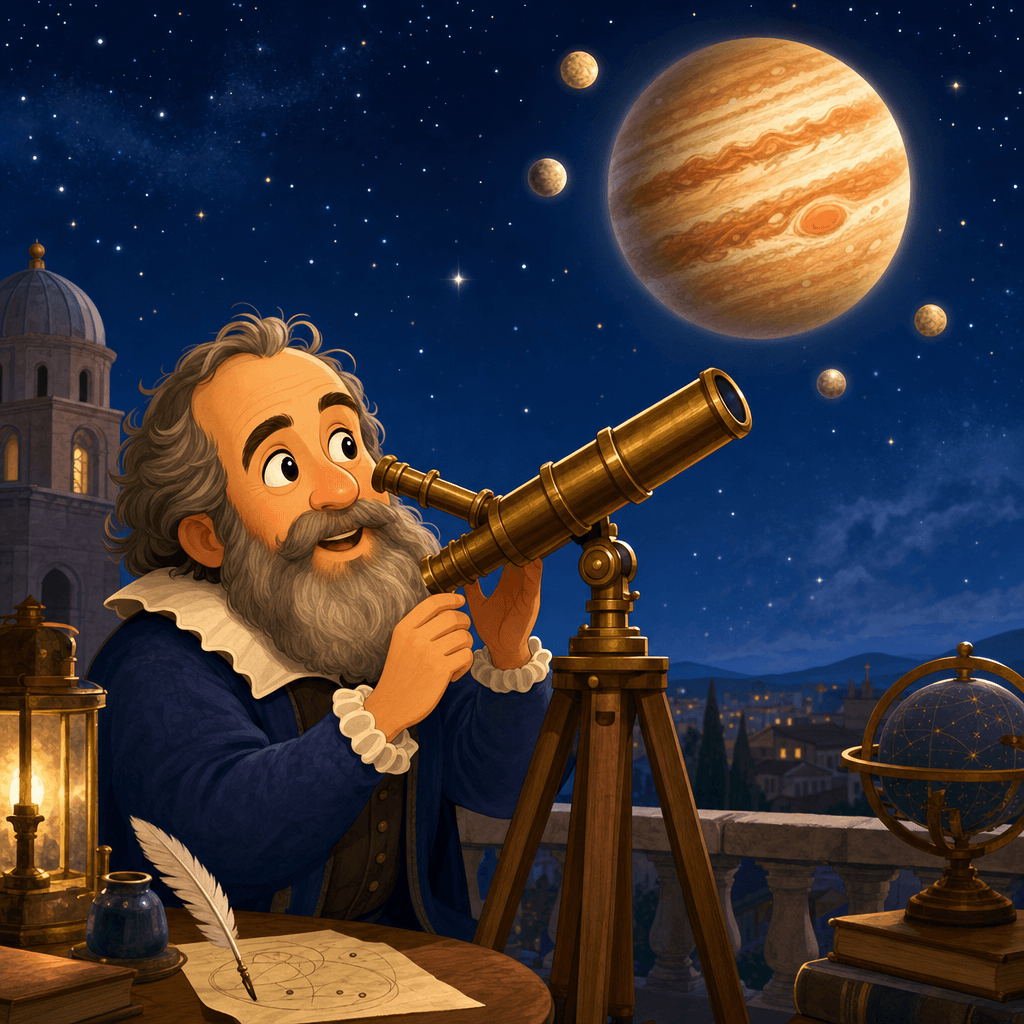
Galileo Galilei helped change science by doing something that sounds very simple: he looked carefully. In about 1609, after learning about the telescope, he built his own improved version and turned it toward the sky.
He observed the Moon, the planets, the Sun, and the Milky Way in new ways. Suddenly, the heavens did not look as perfect and unchanging as many people had believed. Galileo’s telescope did not merely make things bigger; it made old ideas easier to test.
The Moon Was Not Smooth
One of Galileo’s important discoveries was that the Moon’s surface is rough and uneven. Before that, many thinkers believed heavenly bodies must be perfectly smooth.
Galileo’s telescope showed shadows, shapes, and craters. That mattered because it challenged a comfortable idea people had accepted for centuries. He used direct observation to say, in effect, “The sky is telling us something different from what we expected.”
Jupiter’s Moons Changed the Story
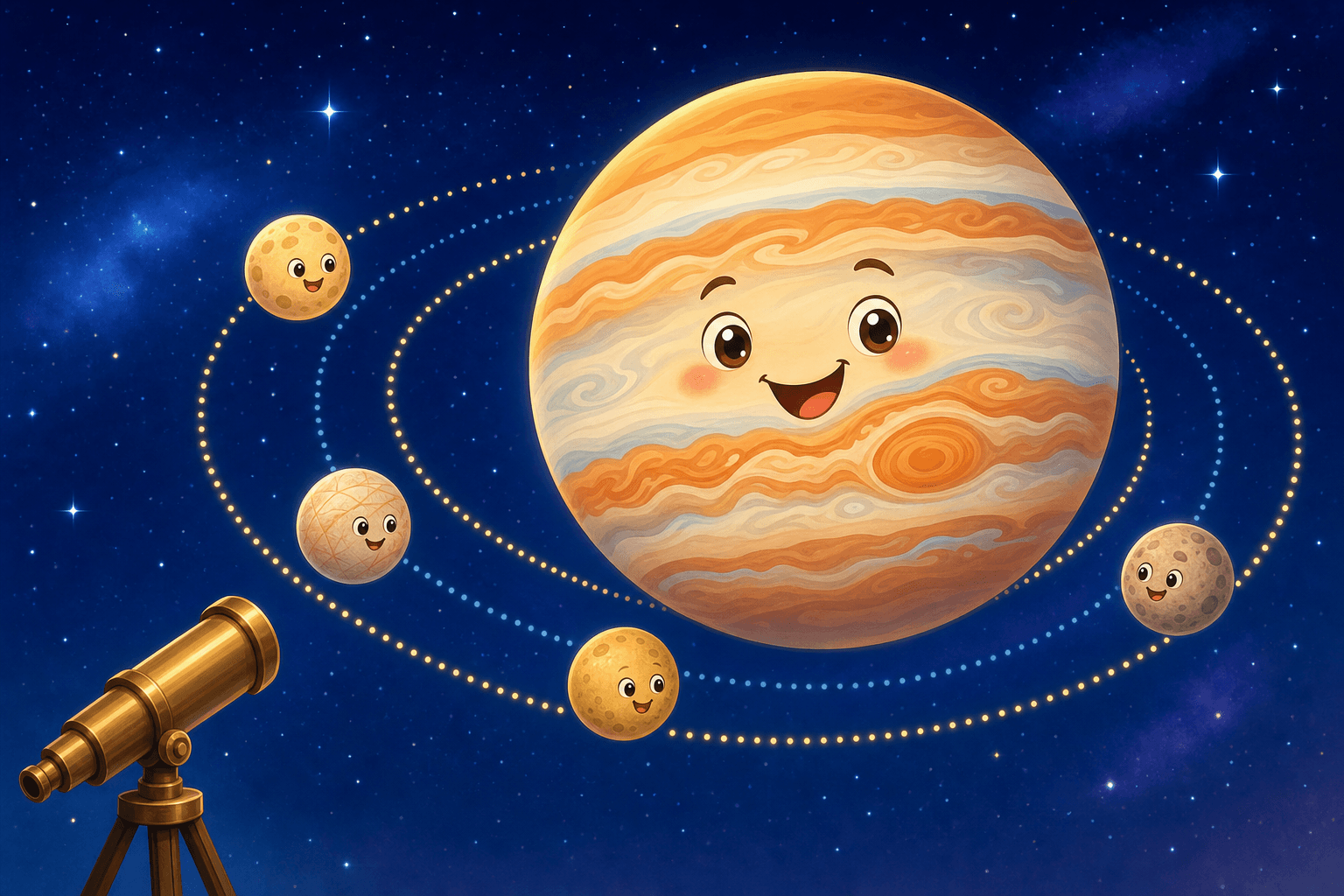
Galileo is especially famous for discovering four large moons around Jupiter in 1610. We now call them the Galilean moons because of that discovery.
This was a big scientific shock. If these moons were orbiting Jupiter, then not everything in the universe was circling Earth. That gave powerful support to the idea that Earth was not the center of everything. Sometimes one observation can change an entire worldview.
Galileo and Motion
Galileo did not only study the sky. He also made major contributions to the science of motion, including how falling objects move and the curved paths of thrown objects.
Older ideas claimed that heavier objects should fall much faster than lighter ones, but Galileo argued that motion should be studied with experiment and mathematics. Later scientists, including Newton, built on that foundation.
How Galileo Worked
- He observed carefully instead of just trusting old authority.
- He used mathematics to describe what he saw.
- He tested ideas against the real world, again and again.
Quick Facts About Galileo’s Science
He proved the Moon has mountains and craters.
His telescope revealed shadows and rough terrain, ending the idea that the sky was perfectly smooth.
He found four moons circling Jupiter.
Seeing moons orbit another planet showed that not everything revolves around the Earth.
He didn’t invent the telescope; he improved it.
Galileo built a much better version and was one of the first to point it carefully at the night sky.
Why Galileo Still Matters
Galileo still matters because modern science still depends on his style of thinking. Astronomers continue to look outward with better and better instruments, and they still rely on observation, mathematics, and evidence.
Students still learn that it is okay to question an accepted answer if new evidence says otherwise. Galileo’s telescope opened a new window on the universe, but his larger gift was showing that nature can be studied carefully and honestly.