Ada Lovelace Facts for Kids
The mathematician who saw, more than 180 years ago, that a machine could do far more than sums.
A Famous Father She Never Knew
Ada Lovelace was born Augusta Ada Byron on December 10, 1815, in London, England. Her father was Lord Byron, one of the most famous poets of his time. Her mother was Anne Isabella Milbanke, known as Lady Byron.
Ada’s parents separated when she was about a month old. In April 1816 her father left England, and Ada never saw him again. He died in Greece in 1824, when she was eight years old.
Lessons Instead of Poems
Lady Byron worried that Ada might grow up dreamy and wild, like her father. So she made sure Ada had lessons in mathematics and science. That was very unusual for a girl at that time. Ada was taught at home by a series of tutors.
Ada was often ill. In 1829, when she was 13, she caught measles and was sick for a long time. For a while she could not walk, and she needed crutches as she slowly got better.
The Girl Who Wanted to Fly
When Ada was about 12, she decided she wanted to fly. She studied birds to work out how big wings needed to be compared with a body, and she thought about which materials could make good wings. She even planned a book about it, which she called Flyology.
Her flying machine was never built. But it shows how Ada liked to think: look closely at nature, measure carefully, then design a machine.
Meeting Charles Babbage
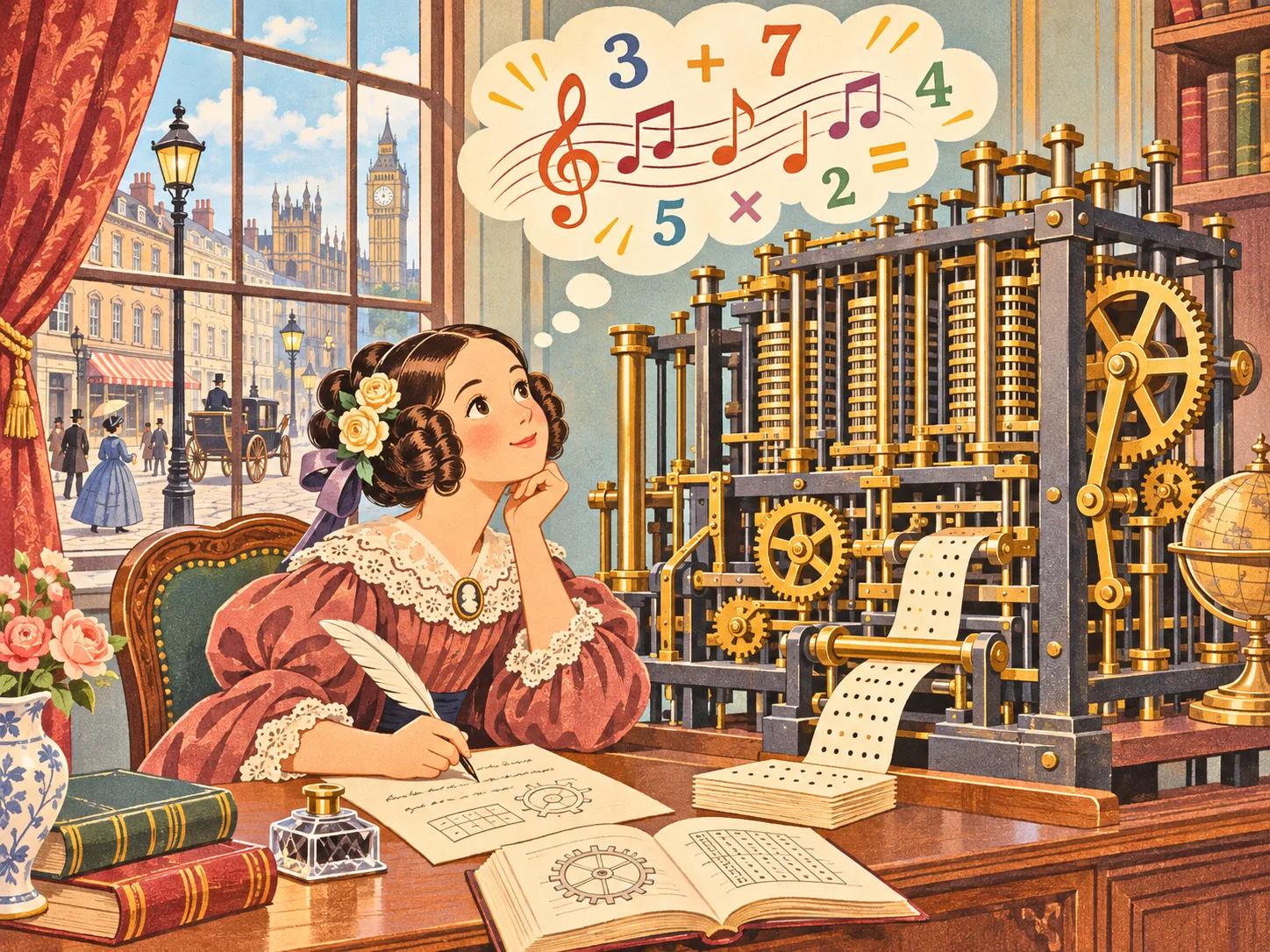
On June 5, 1833, when she was 17, Ada went to a party in London given by Charles Babbage, a mathematician and inventor. Soon afterwards, Babbage showed her a working piece of his Difference Engine, a calculating machine made of brass gears and wheels. Most visitors simply stared at it. Ada wanted to know how it worked.
Ada and Babbage became good friends. For years they wrote letters to each other about mathematics and machines.
A Countess Who Kept Learning
In 1835, Ada married William King. In 1838 he was made the Earl of Lovelace, so Ada became the Countess of Lovelace. That is why we know her as Ada Lovelace. They had three children, called Byron, Annabella and Ralph.
Ada kept on studying. The famous scientist Mary Somerville became her friend and helped her with mathematics. Later, Ada took advanced mathematics lessons by letter from Augustus De Morgan, a professor in London.
The Analytical Engine
Babbage had an even bigger idea, a machine he called the Analytical Engine. It was meant to run on steam and to follow instructions punched as holes in cards, like the cards that told Jacquard weaving looms which pattern to weave. It would have had one part that stored numbers and another part that worked on them, a bit like the memory and processor in a computer today.
The Analytical Engine was never finished. Babbage made detailed plans and built only a small test piece. Today it is seen as the first design for a general-purpose computer, which means a machine that could be set up to do many different jobs.
The Famous Notes of 1843
In 1840, Babbage gave a talk about the Analytical Engine in Turin, Italy. An Italian engineer named Luigi Menabrea wrote an article about it in French, which was printed in 1842. Ada translated the article into English and added her own notes. Her notes ended up about three times longer than the article itself!
The translation and notes were published in 1843, signed only with her initials, A.A.L. In the last note, now called Note G, Ada set out step by step how the engine could work out a tricky list of numbers called Bernoulli numbers. Many people call this the first computer program ever published. Historians still argue about how much of it came from Babbage, but the notes show that Ada understood the machine deeply and had big ideas of her own.
Machines That Do More Than Sums
Ada saw something that most people at the time missed. She wrote that the engine could work with more than numbers. If things like musical notes could be written as symbols, she said, the engine might even compose music.
Today computers handle words, pictures, music and games, just as she imagined. Ada called her way of thinking poetical science, because it mixed imagination with careful mathematics.
What Ada Saw Coming
- A machine could follow a list of steps, one after another, to solve a problem.
- The same steps could be repeated many times, which saves writing them out again.
- Symbols in a machine could stand for things other than numbers, such as musical notes.
- A machine only does what it is told, so people still have to do the thinking and give it good instructions.
Her Last Years
Ada was often unwell, and her health got worse in her thirties. She died of cancer on November 27, 1852, when she was only 36, the same age her father was when he died.
At her own request, she was buried next to her father, in the church of St Mary Magdalene in Hucknall, near Nottingham in England.
Fun Facts About Ada Lovelace
A computer language is named after her.
In 1980, the US Department of Defense approved a programming language called Ada, named in her honor. It is still used today for things like aircraft systems.
She has her own day.
Ada Lovelace Day is held on the second Tuesday of October. It started in 2009 and celebrates women in science, technology, engineering and maths.
Babbage called her an enchantress.
In a letter to the scientist Michael Faraday, Babbage described Ada as that Enchantress, because of the way she understood mathematics.
She compared the engine to a loom.
She wrote that the Analytical Engine weaves algebraical patterns just as the Jacquard loom weaves flowers and leaves.
Questions kids ask
What is Ada Lovelace famous for?
In 1843 she published detailed notes about Charles Babbage’s Analytical Engine, a computer that was planned but never finished. The notes include a step-by-step method for the machine, which many people call the first computer program.
Did Ada Lovelace invent the computer?
No. Charles Babbage designed the Analytical Engine. Ada explained what it could do and how to give it instructions, and she saw that machines like it could one day work with music and other things besides numbers.
Was Ada Lovelace related to Lord Byron?
Yes. She was the only child the poet Lord Byron had with his wife, Lady Byron. Her parents separated when she was a baby, and she never got to know her father.
How old was Ada Lovelace when she died?
She was 36. She died in London on November 27, 1852.
Why Her Story Still Matters
Ada lived long before anyone had built a computer, yet she imagined machines that could follow instructions and work with music and symbols. Today that is exactly what computers do.
Her story shows that mathematics and imagination work best together. Every time you give a computer a clear set of steps to follow, you are doing what Ada described back in 1843.
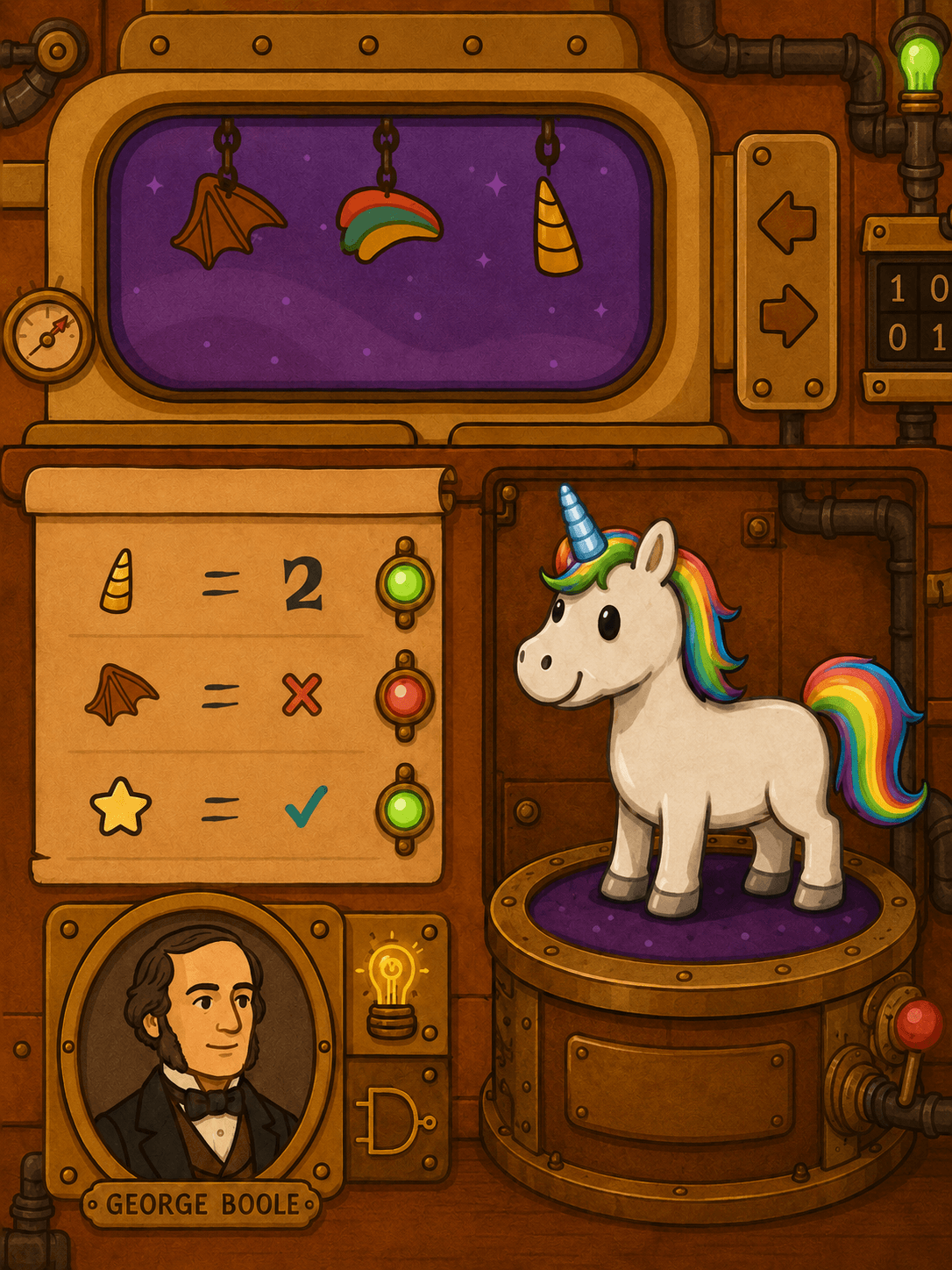
Boole's Creature Machine
Computers follow rules that are either true or false. Build, sort and solve with true-or-false logic in a playful machine, one clear step at a time!