Alexander Fleming Facts for Kids
The Scottish scientist who came back from holiday, found a mould killing his germs and discovered penicillin.
A Farm Boy From Scotland
Alexander Fleming was born on August 6, 1881, at Lochfield, a hill farm in Ayrshire, in the south-west of Scotland. His family called him Alec. He was the seventh of eight children, and his father died when Alec was only seven years old.
Alec spent his days roaming the moors and fields around the farm. Years later, people said that all that time spent watching nature had made him very good at noticing small things that other people missed. That skill would one day change medicine.
From Shipping Clerk to Doctor
When he was 13 or 14, Alec moved to London to live with his older brother Tom, who was a doctor. He went to classes at a college called the Regent Street Polytechnic, and then he got a job as a clerk in a shipping office, filling in forms and keeping records.
Office work did not suit him. In 1901 he won a scholarship to St Mary’s Hospital Medical School in London. He did so well that St Mary’s became his work home for the rest of his life. In 1906 he joined a team led by Sir Almroth Wright that studied how vaccines and the body’s own defences fight germs.
Germ Detective in a War
During World War One, Fleming worked in a hospital laboratory in Boulogne, in France, studying soldiers’ wounds. Many wounds became badly infected, and doctors poured strong chemicals called antiseptics into them to kill the germs.
Fleming found a problem. In deep, jagged wounds the antiseptics did not reach all the germs, and they also harmed the white blood cells that the body uses to fight infection. He began to dream of a germ killer that would attack bacteria without hurting the body.
A Germ Killer in Your Tears
In 1921, Fleming made his first big discovery. He found that nasal mucus, the slimy stuff in your nose, could break down some kinds of bacteria. He later found the same substance in tears, saliva and other body fluids, and he named it lysozyme.
Lysozyme showed that the body makes its own germ fighters. But it worked best on harmless bacteria and not very well on the ones that make people sick. Fleming kept looking.
The Forgotten Dish
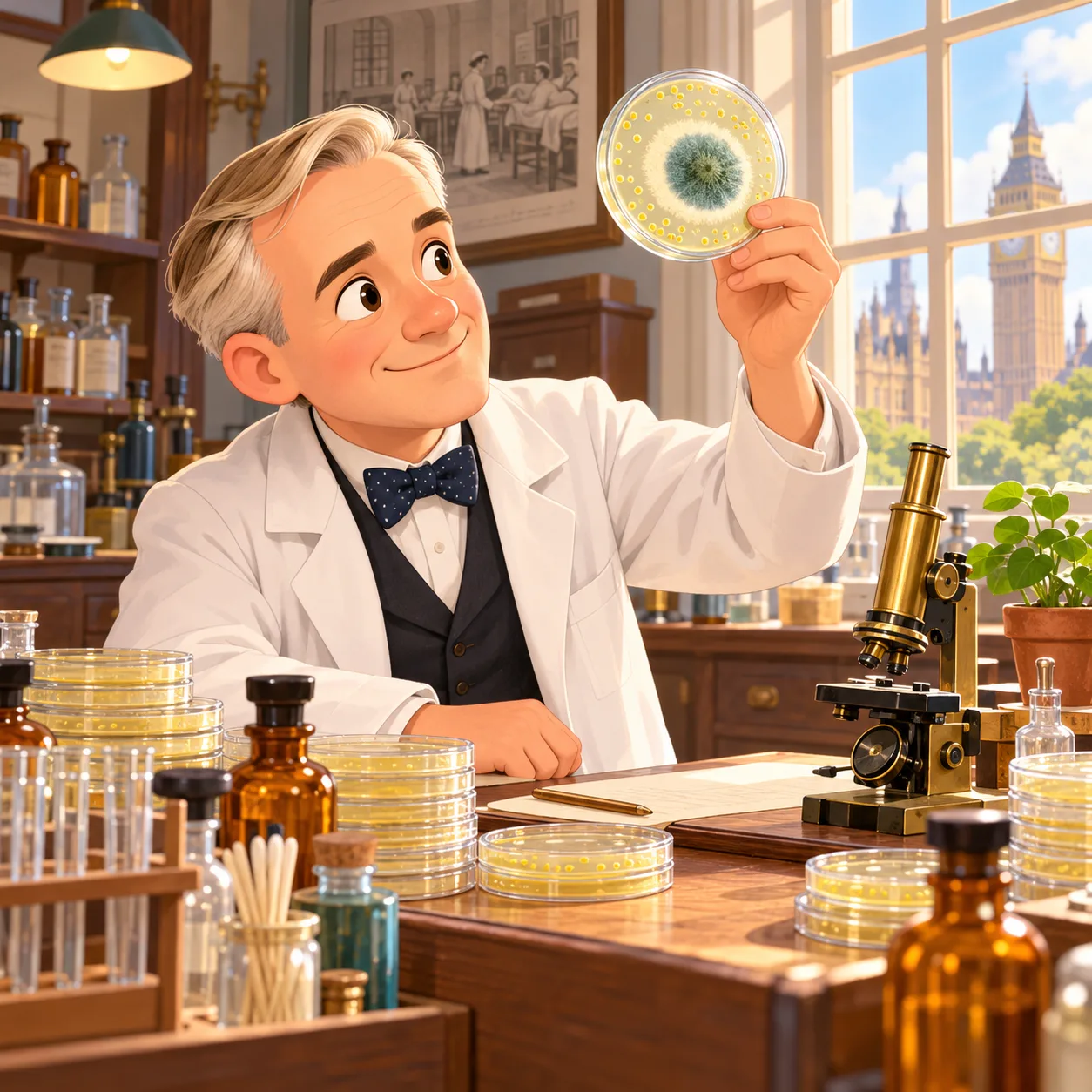
In the summer of 1928, Fleming was studying Staphylococcus, a kind of bacteria that can cause boils and dangerous infections. He grew it in shallow glass dishes, called Petri dishes, on a layer of jelly-like food. Then he went away on a summer holiday.
One of the dishes was left out on his lab bench instead of being kept in a warm cupboard. At some point, perhaps even before he left, a tiny speck of mould, called a spore, landed on it. It probably floated up from a lab on the floor below, where another scientist was growing moulds.
When Fleming came back in September 1928, he noticed something strange. A fluffy patch of mould was growing on the dish, and the bacteria close to it had disappeared. Something coming out of the mould was killing them.
How Fleming Worked
- He noticed odd results instead of throwing them away. Many scientists would have washed that dish.
- He grew the mould on its own and tested its juice against many kinds of bacteria.
- He wrote up what he found in 1929, so other scientists could build on it.
Naming Penicillin
The mould was a kind of Penicillium, a relative of the moulds that can grow on old bread and fruit. Fleming named the germ-killing substance it made penicillin. He showed that it could stop many harmful bacteria, and that it did not seem to harm animals.
But there was a big problem. Fleming could not make penicillin pure or strong enough, and it fell apart quickly. He wrote about it in a science journal in 1929, but for about ten years hardly anyone paid attention.
The Oxford Team Finishes the Job
In 1939, a team at the University of Oxford, led by Howard Florey and Ernst Chain, picked up Fleming’s idea. With the help of Norman Heatley, they found a way to make purer penicillin. In May 1940 they tested it on mice infected with deadly bacteria. The mice that got penicillin survived, and the mice that did not get it died.
In 1941 they treated their first patient, a policeman named Albert Alexander. He started to get better, but the team ran out of penicillin and he died. They needed much more. Factories in the United States took over, and by 1944 there was enough penicillin to treat many of the soldiers wounded in the D-Day landings.
Fame, a Nobel Prize and a Warning
Fleming became famous all over the world. He was knighted in 1944, so he became Sir Alexander Fleming. In 1945 he shared the Nobel Prize in Physiology or Medicine with Florey and Chain.
In his Nobel Prize speech, Fleming gave a warning. He had seen that bacteria can become resistant, which means penicillin stops working on them, if they meet too little of it to kill them. He said that people who take too little penicillin could help resistant germs spread. He was right. Today doctors call this antibiotic resistance, and it is one reason you should always take medicine exactly as a doctor says.
Fleming died in London on March 11, 1955, at the age of 73. He is buried in St Paul’s Cathedral in London, a resting place kept for some of Britain’s most honoured people.
Fun Facts About Fleming
He painted pictures with germs.
Fleming used bacteria that grow in different colours to make living paintings on dishes of jelly, such as houses, soldiers and ballerinas. He also belonged to an artists’ club in London.
A cold helped him find a germ killer.
His discovery of lysozyme came from nasal mucus. The same germ-fighting substance is in your tears and saliva.
Penicillin comes from a mould.
It is made by a mould called Penicillium, a relative of the blue-green fuzz you sometimes see on old bread.
You can visit his lab.
The room at St Mary’s Hospital in London where he found penicillin has been set up to look as it did in 1928, and it is now a small museum.
Questions kids ask
What is Alexander Fleming most famous for?
He is most famous for discovering penicillin in 1928. Penicillin became the first antibiotic to be used widely. Antibiotics are medicines that kill harmful bacteria.
How did Alexander Fleming discover penicillin?
He left some dishes of bacteria on his bench when he went on holiday. A mould spore had got onto one of them, and when he came back he saw that the bacteria around the mould had been killed. He named the germ-killing substance penicillin.
Did Alexander Fleming make penicillin into a medicine by himself?
No. He could not make it pure or strong enough. A team at Oxford led by Howard Florey and Ernst Chain turned it into a real medicine around 1940, and they shared the 1945 Nobel Prize with Fleming.
Where was Alexander Fleming from?
He was born on a farm in Ayrshire, Scotland, in 1881. He moved to London as a teenager and did his most famous work at St Mary’s Hospital there.
Why His Story Still Matters
Every time a doctor gives someone an antibiotic for an infection, Fleming’s discovery is at work. It all began with a messy bench, a forgotten dish and a scientist who looked closely instead of throwing it away.
His story also shows that science is teamwork. Fleming noticed the mould, the Oxford team turned it into a medicine and factories made enough of it to save lives. Each part needed the others.
Koch's Culture Lab
Grow germs in dishes, look at them up close and work out which microbe is making people sick, just like the great germ hunters!