Louis Pasteur Facts for Kids
The chemist who proved germs come from other germs, kept food from spoiling and made the first rabies vaccine.
A Tanner’s Son Who Loved to Draw
Louis Pasteur was born on December 27, 1822, in Dole, a small town in eastern France. His father, Jean-Joseph Pasteur, was a leather tanner. When Louis was still a small child, the family moved to the nearby town of Arbois, where he grew up.
As a boy, Louis loved drawing and painting. Some of the pictures he made as a teenager are still kept at the Pasteur Institute in Paris today. Looking closely at faces and colors turned out to be good practice for a scientist who would spend his life looking closely at very tiny things.
Mirror-Image Crystals
Pasteur studied science in Paris at a famous school called the École Normale Supérieure, and he earned his doctorate in 1847. He was a chemist, a scientist who studies what things are made of and how they change.
His first big discovery was about crystals made from tartaric acid, a substance found in grapes. He noticed that some of the crystals came in two shapes that were mirror images of each other, like your left hand and your right hand. The two kinds even twisted a special kind of light in opposite directions. That discovery started a whole new branch of chemistry.
Tiny Living Workers
In 1854, Pasteur moved to the city of Lille in northern France to lead its science faculty. Local factories made alcohol from sugar beet juice, but some batches kept going wrong. Pasteur put drops under his microscope to find out why.
He found that fermentation, the change that turns sugary juice into alcohol, is done by yeast, a living thing far too small to see without a microscope. When other microbes got into a batch, they made the wrong product and spoiled it. The idea that tiny living things can change food, for good or for bad, was the start of his work on germs.
Pasteurization: Gentle Heat That Saves Food
French wine makers had a costly problem: their wine kept going bad. Pasteur showed that microbes were to blame, and he found a simple fix. Heating the wine to about 55 to 60 degrees Celsius killed the spoiling microbes without boiling it. He later taught brewers to do the same with beer.
This gentle heating is called pasteurization, after him. Today the same idea keeps milk and juice safe to drink. Check a milk carton at home, and you will probably find the word pasteurized printed on it.
The Swan-Neck Flask Experiment
In Pasteur’s time, many people believed in spontaneous generation: the idea that tiny living things could appear all by themselves in a liquid like broth. Pasteur wanted to test it.
He poured broth into glass flasks and heated their necks until he could bend them into a long S shape, like a swan’s neck. Then he boiled the broth to kill any microbes inside. Air could still reach the broth, but dust and germs from the air got stuck in the bend of the neck. The broth stayed clear.
When a neck was broken off, dust could fall straight in, and soon the broth turned cloudy with microbes. The answer was clear: microbes do not appear from nothing. They come from other microbes, carried by air and dust. Pasteur reported these experiments in 1862.
How Pasteur Worked
- He tested ideas with careful experiments instead of trusting old beliefs.
- He set flasks side by side, so he could see exactly what made the difference.
- He kept working even after a stroke in 1868 left one side of his body partly paralyzed.
Sick Silkworms and a Brave Comeback
In 1865, a disease was killing the silkworms that French silk farmers depended on. Pasteur had never studied silkworms, but he took on the problem. He found that the worms were suffering from two different diseases, and he worked out a way to check the moths under a microscope and keep only healthy eggs.
In 1868, in the middle of this work, Pasteur had a stroke that left the left side of his body partly paralyzed. Within about three months he was directing the silkworm studies again, and he went on working for more than 25 years.
The First Vaccines
A vaccine trains the body to fight a germ before the real germ arrives. Pasteur discovered that germs weakened in the lab could protect animals instead of making them very sick. In 1881 he held a famous public test on a farm at Pouilly-le-Fort, near Paris. Every vaccinated animal survived anthrax, a deadly disease of sheep and cattle, while the sheep and goats that had not been vaccinated died.
Then he turned to rabies, a disease people can catch from the bite of an infected animal. At that time there was no cure. In July 1885, a nine-year-old boy named Joseph Meister was brought to Paris after a rabid dog bit him 14 times. The vaccine had only been tested on dogs and rabbits, and Pasteur was not a medical doctor, so Dr. Joseph Grancher gave Joseph the injections over ten days. Joseph survived. He was the first person saved by the rabies vaccine.
Pasteur and Koch: Rival Germ Hunters
Pasteur was not the only germ hunter of his time. In Germany, Robert Koch was finding the exact bacteria behind diseases like tuberculosis. The two scientists were rivals. Their countries had recently fought a war against each other, they spoke different languages, and they argued in public about anthrax.
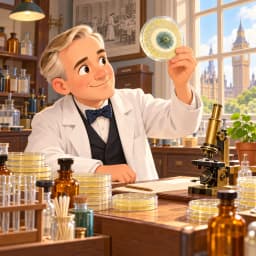
But their work fit together like two halves of a puzzle. Pasteur showed that germs come from other germs and that weakened germs can make vaccines. Koch showed how to grow one kind of germ on its own and match it to one disease. Together, they convinced the world that germs cause disease.
The Pasteur Institute
So many people came to Paris for the rabies vaccine that a new center was built to treat them and to study germs. The Pasteur Institute opened on November 14, 1888, and Pasteur lived in an apartment there for the rest of his life.
Pasteur died on September 28, 1895, at the age of 72. He is buried in a crypt inside the institute he founded, and the Pasteur Institute is still a busy research center where scientists study germs and work on new vaccines.
Fun Facts About Pasteur
He was a talented artist as a teenager.
Drawings and paintings he made in those years are still kept at the Pasteur Institute in Paris.
Pasteurized milk is named after him.
Pasteurization, the gentle heating that kills spoiling microbes, carries his name.
He invented the words aerobic and anaerobic.
Aerobic means living with air, and anaerobic means living without it. He came up with the words after finding microbes that live without oxygen.
His most famous patient was nine years old.
Joseph Meister, the first person saved by the rabies vaccine, was a nine-year-old boy from Alsace.
Questions kids ask
What is Louis Pasteur most famous for?
He is most famous for pasteurization, the gentle heating that keeps food and drinks from spoiling, for proving that germs come from other germs, and for making the first rabies vaccine in 1885.
What three things did Louis Pasteur discover?
Three of his biggest discoveries are that living yeast causes fermentation, that microbes come from other microbes and not from nothing, and that weakened germs can be used as vaccines.
Was Louis Pasteur a doctor?
No. He was a chemist. He studied crystals and fermentation before he ever worked on diseases, and a doctor gave the injections when his rabies vaccine was first used on a person.
Did Louis Pasteur and Robert Koch work together?
No. They were rivals, one in France and one in Germany. But their discoveries fit together, and between them they showed the world that germs cause disease.
Why His Story Still Matters
Every time you drink pasteurized milk, get a vaccine or see a doctor clean their hands and tools, you are seeing Pasteur’s ideas at work. He showed that germs make food spoil and people sick, that they come from other germs, and that we can stop them.
He also shows how good science works. Pasteur asked a clear question, built a clever test and trusted the results, even when they went against what most people believed.
Koch's Culture Lab
Grow and study microbes like Pasteur and Koch, and find out which germ is making people sick!