Antonie van Leeuwenhoek Facts for Kids
The Dutch cloth seller who made his own tiny microscopes and became the first person to see bacteria.
A Boy From Delft
Antonie van Leeuwenhoek was born on October 24, 1632, in Delft, a busy town of canals in the Dutch Republic, which is now the Netherlands. His father made baskets, and his mother came from a family of brewers.
Antonie went to school in a nearby town and later lived with an uncle. He never went to university, and Dutch was the only language he really knew. That did not stop him. He would one day write to some of the most famous scientists in Europe.
A Cloth Seller With a Magnifying Glass
When he was 16, Antonie started training in a shop that sold linen and other cloth. Around 1654 he moved back to Delft and opened his own cloth shop. He lived in Delft for the rest of his long life.
People who sold cloth used magnifying glasses to check how fine and even the threads were. Many historians think this is what first got Antonie interested in lenses. Over the years he also worked for the town as an official, a surveyor who measured land and a checker of wine barrels.
Tiny Lenses, Big Views
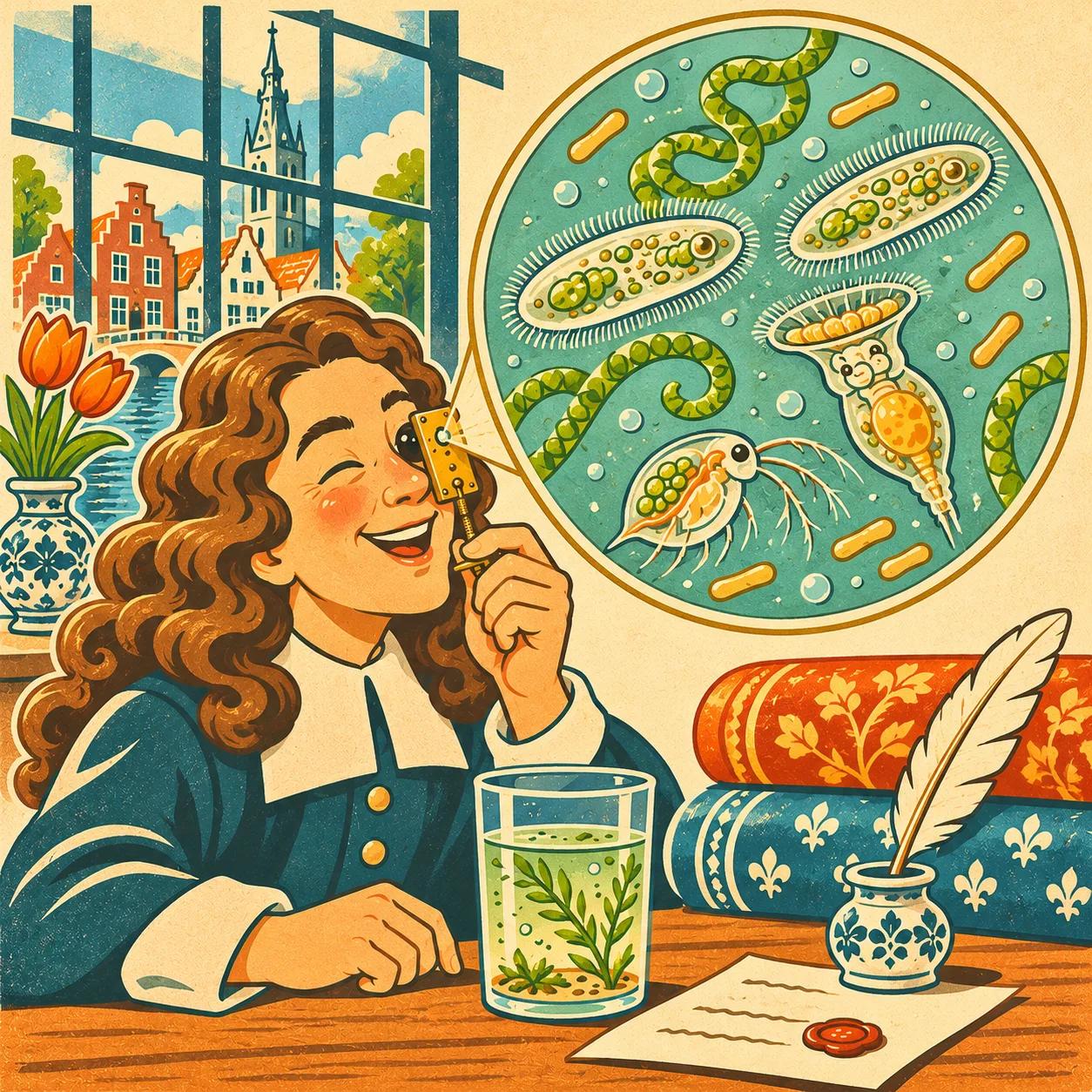
By 1668, Antonie had learned to make lenses. His microscopes looked nothing like the ones in schools today. Each one was a small flat metal plate, shorter than your hand, with one tiny glass lens set into a hole. He stuck the thing he wanted to look at on a pin, turned little screws to move it into place and held the microscope right up to his eye, facing the light.
Other microscopes of that time used two or more lenses, but they made things look only about 20 or 30 times bigger. Antonie’s best lenses made things look more than 200 times bigger. He made more than 500 lenses, and he never told anyone exactly how he made his best ones.
Letters to London
In 1673, a Delft doctor named Reinier de Graaf told the Royal Society in London about Antonie’s work. The Royal Society was a club of scientists who shared new discoveries. Antonie wrote them a letter about what he had seen, including a close look at a bee’s sting.
It was the first of many letters. For about 50 years he kept writing, always in Dutch. The Royal Society translated his letters and printed many of them in its science journal. He could not draw well, so he paid an artist to draw what he saw.
The Little Animals in Lake Water
In 1674, Antonie looked at a drop of water from a lake near Delft. He saw green spiral strands, which scientists think were probably a kind of algae. He also saw tiny creatures swimming and spinning in the drop.
No one had ever seen tiny swimming creatures like these before. Antonie called them little animals. When his letters were turned into English, the translators called them animalcules, which means tiny animals.
Pepper Water and a Famous Letter
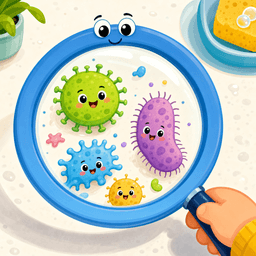
In a long letter dated October 9, 1676, Antonie described the little animals he had found in rainwater, well water, sea water, melted snow and water with crushed pepper soaked in it. He said a single drop could hold many thousands of them. Some of the smallest may have been bacteria.
Many scientists in London did not believe him at first, because their microscopes were not good enough to see what he saw. People who visited him in Delft, including church ministers, wrote to London to say that his reports were true. Then the English scientist Robert Hooke made a stronger microscope and saw the little animals for himself.
Germs on His Teeth
In 1683, Antonie tried something new. He scraped a little of the white stuff from between his teeth, which is called plaque, and mixed it with clean water. Under his microscope, it was full of tiny living things moving about.
He also looked at plaque from two women and two old men. Today scientists agree that these were bacteria. The drawings in this letter are some of the first pictures of bacteria ever made.
What Else He Saw
- Red blood cells, the tiny round cells that carry oxygen around your body.
- Blood flowing through very thin tubes, called capillaries, in the tail of an eel.
- Bell-shaped creatures with waving hairs, and tiny animals called rotifers, whose rings of beating hairs look like spinning wheels.
- Tiny shells no bigger than a grain of sand, made by living things called foraminifera.
Fame Without Leaving Home
In 1680, the Royal Society made Antonie a member, which was a great honour. He never went to one of its meetings. Instead, important visitors came to see him in Delft. In the late 1690s, Tsar Peter the Great of Russia came to see him, and Antonie showed him blood flowing through the tail of an eel.
Antonie kept looking through his lenses and writing letters almost until the end of his life. He died in Delft in 1723, at the age of 90.
Fun Facts About Antonie van Leeuwenhoek
He helped a famous painter’s family.
The painter Johannes Vermeer was born in Delft in the same year as Antonie. After Vermeer died, his family was deep in debt, and in 1676 the town put Antonie in charge of sorting out the money.
Only a few of his microscopes survive.
He made hundreds of lenses, but fewer than a dozen of his microscopes are known today. The strongest one makes things look about 266 times bigger.
His samples were found 300 years later.
He sometimes mailed tiny samples to London with his letters. Some of them were found again in the Royal Society’s archives about three centuries later.
He wrote everything in Dutch.
Many scientists of his time wrote in Latin, but Antonie knew only a little Latin from school. He wrote all his letters in Dutch, and others translated them.
Questions kids ask
What is Antonie van Leeuwenhoek famous for?
He was the first person to see and describe bacteria and other tiny living things, using microscopes he made himself. He is often called the Father of Microbiology.
Did Antonie van Leeuwenhoek invent the microscope?
No. Microscopes with two or more lenses were invented around 1595, before he was born. He made a different kind, with one tiny lens, that showed things far more clearly than other microscopes of his time.
What did Antonie van Leeuwenhoek call bacteria?
He called the tiny creatures he saw little animals. In English translations of his letters they were called animalcules.
How did his work help later scientists?
He showed that a whole world of tiny living things exists. Almost 200 years later, scientists such as Louis Pasteur and Robert Koch proved that some of these microbes cause diseases.
Why His Story Still Matters
Before Antonie, nobody knew that a drop of water or a speck from your teeth could be full of life. He showed people a hidden world that is all around us and even inside us.
He was not a professor or a doctor. He was a shopkeeper who was curious, patient and very good at making things. His story shows that careful looking, and writing down exactly what you see, can change science.
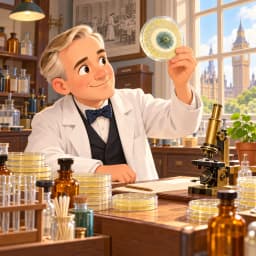
Koch's Culture Lab
Grow germs in dishes, look at them up close and work out which microbe is making people sick, just like the great germ hunters!