How Do Prisms Work?
How a simple triangle of glass bends light and splits it into a rainbow.
A Rainbow in a Triangle of Glass
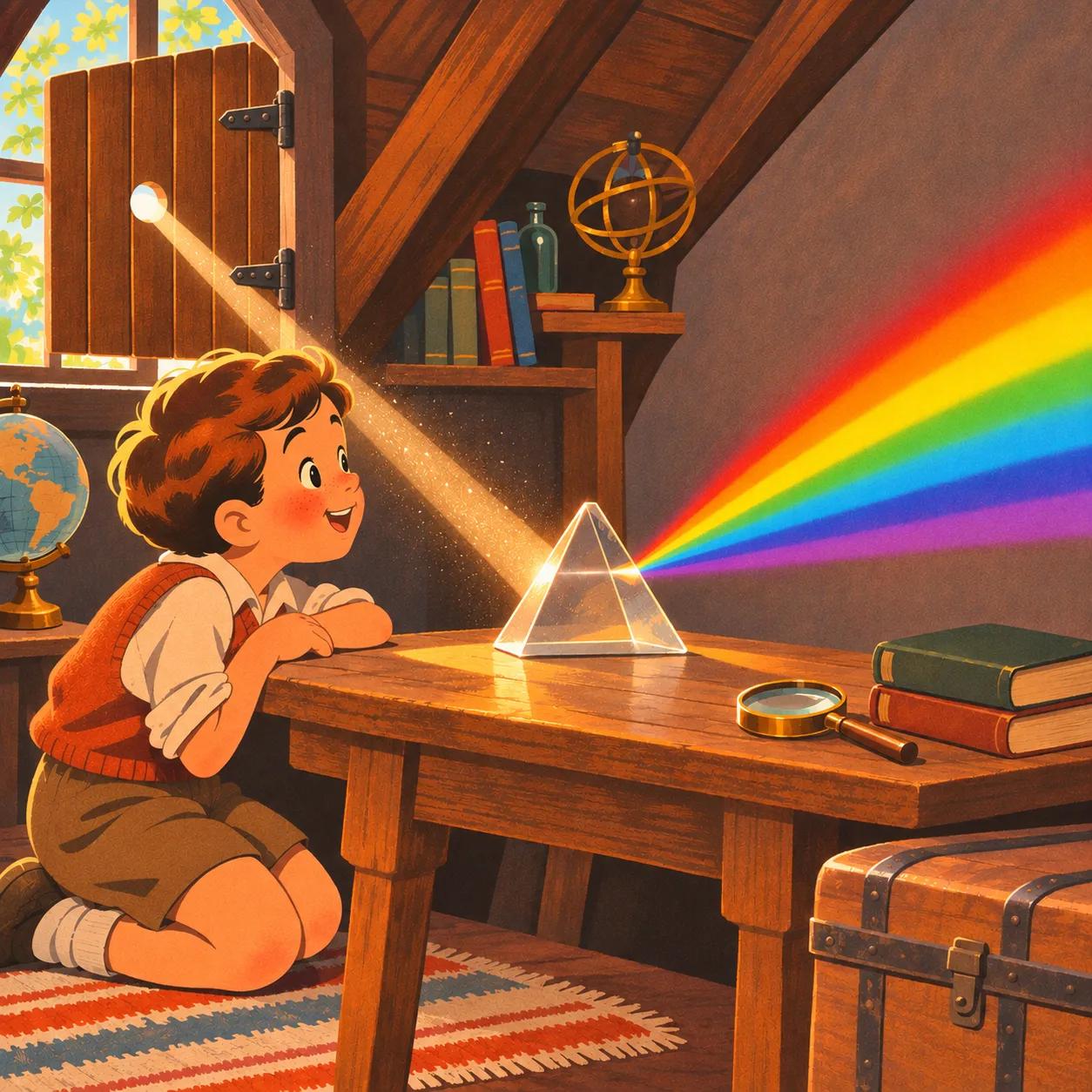
Shine a beam of sunlight into a small, triangle-shaped piece of glass, and something amazing comes out the other side: a stripe of red, orange, yellow, green, blue and violet. That piece of glass is called a prism.
A prism is a piece of clear material, usually glass, with flat, smooth sides set at angles to each other. The most famous kind has a triangle shape at each end. Prisms do not add any color to light. The colors were hiding inside the white light all along, and the prism simply pulls them apart.
Light Slows Down in Glass
To understand a prism, you first need to know one surprising fact: light changes speed when it goes from one material into another. In air, light zooms along at about 300,000 kilometers every second. In glass, it slows down to about 200,000 kilometers per second.
When a beam of light hits glass at a slant, that change of speed makes it change direction. Scientists call this bending refraction. Think of a shopping cart rolling at an angle from a smooth floor onto a carpet. The wheel that reaches the carpet first slows down first, so the whole cart turns. Light does something similar when it enters glass.
Why the Colors Come Apart
White light, like sunlight, is really a mix of many colors traveling together. Inside glass, each color is bent by a slightly different amount. Violet light bends the most and red light bends the least. The other colors land in between.
A prism bends light twice: once on the way in and again on the way out. Because its sides are tilted toward each other, the second bend adds to the first instead of undoing it. So the colors spread out more and more, and they come out as a fan of separate colors. This spreading out is called dispersion.
The Colors of the Spectrum
- Red bends the least, so it ends up at one edge of the rainbow stripe.
- Orange and yellow come next.
- Green sits in the middle.
- Blue and indigo bend more.
- Violet bends the most, so it ends up at the other edge.
Isaac Newton’s Famous Experiment
Long ago, many people thought a prism somehow stained white light to make colors. In 1666, a young Isaac Newton decided to test that idea. He darkened his room, let a thin beam of sunlight in through a small hole, and sent it through a triangular glass prism. A long band of colors appeared on the far wall.
Then came his clever test. Newton blocked off all the colors except one and sent that single color through a second prism. The light bent again, but it did not change color. Red stayed red. In other tests, he used another prism to bring the colors back together, and they made white light again.
Newton’s conclusion was that white light is a mixture of all the colors, and a prism only separates them. He called the band of colors a spectrum. He wrote about his discoveries in 1672 and later in a big book about light called Opticks, published in 1704.
Raindrops Are Tiny Prisms
A rainbow in the sky works in a very similar way. When sunlight shines into falling raindrops, the light bends as it enters each drop, bounces off the inside of the back of the drop, and bends again as it comes out. Each color bends by a slightly different amount, so the colors fan out, just as they do in a prism.
That is why you only see a rainbow when the Sun is behind you and the rain is in front of you. The colored light comes back toward you at an angle of about 42 degrees from the point directly opposite the Sun. It is also why rainbows show up most often in the morning or late afternoon, when the Sun is low in the sky.
Where We Use Prisms Today
Prisms do more than make rainbows. Light can also bounce off the inside face of a prism, almost like a mirror. Many binoculars use prisms this way. Without them, the view would be upside down and back to front. The prisms flip it the right way round and also help make the binoculars shorter.
Scientists also use prisms and similar tools to study stars. When starlight is spread into a spectrum, it shows thin dark or bright lines, like a barcode. Each chemical leaves its own pattern of lines, so the spectrum tells scientists what a star is made of.
Fun Facts About Prisms
Helium was discovered in the Sun before anyone found it on Earth.
During a solar eclipse in 1868, scientists spread the Sun’s light into a spectrum and saw a yellow line no known chemical could explain. The new element was named helium, after the Greek word for the Sun. It was first found on Earth years later.
Two prisms can undo each other.
Newton showed that if you turn a second prism the opposite way, it can gather the colors back together into white light.
A glass of water can act like a prism.
Put a clear glass of water on a sunny windowsill with white paper on the floor below. If the angle is right, a little rainbow will appear on the paper.
Some prisms are named after people.
The Porro prism, used in many binoculars, is named after Ignazio Porro, an Italian inventor who patented it in 1854.
Questions kids ask
How does a prism work in simple words?
Light slows down and bends when it goes into glass. Each color bends by a different amount, so when white light passes through a prism, the colors spread apart and you see a rainbow.
Why does a prism make a rainbow?
Because white light is a mix of colors. Violet light bends the most in glass and red bends the least, so the prism sorts the colors into a band from red to violet.
Who discovered that a prism splits light into colors?
People had seen prisms make colors for a long time, but Isaac Newton showed in the 1660s that the colors were already in white light and that the prism only separated them.
What are prisms used for?
Prisms are used in binoculars to turn the view the right way round, in some cameras, and in science tools that spread out light so scientists can learn what stars are made of.
Try It Yourself
You do not need a fancy lab to see dispersion. On a sunny day, look for the little rainbow a glass of water casts on a windowsill, the colored sparkles from a glass ornament hanging in a window, or the rainbow that appears in the spray of a garden hose when the Sun is behind you.
Each time, you are seeing the same thing Newton saw in his darkened room: white light is really a whole spectrum of colors, waiting to be split apart.
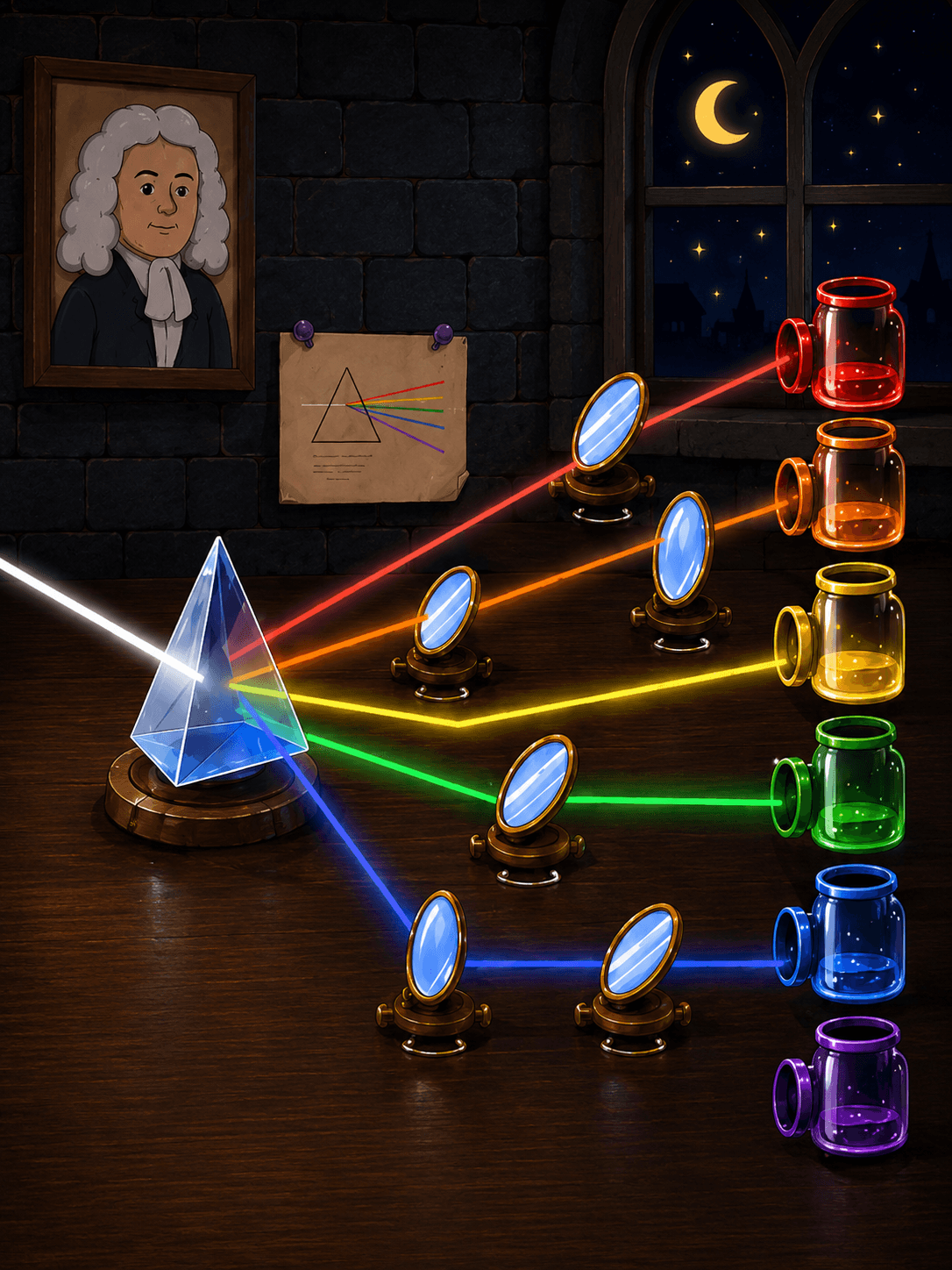
Newton's Prism Lab
Shine a beam of white light through a prism, split it into colors, and guide each color to the right place with mirrors!