Johannes Kepler Facts for Kids
The astronomer who worked out the secret paths of the planets, more than 400 years ago.
A Sickly Boy Who Loved the Sky
Johannes Kepler was born on December 27, 1571, in Weil der Stadt, a small town in what is now southern Germany. His family was not rich, and his father, a soldier, was often away. In the end he left the family for good.
When Johannes was about four, he caught smallpox. He got better, but the illness left him with weak eyesight and damaged hands. That made it hard for him to look through instruments for long, so later in life he did most of his astronomy with numbers instead.
Even so, the sky fascinated him. When he was six, his mother took him up a hill to see the Great Comet of 1577. A few years later, in 1580, he was called outside to watch an eclipse of the Moon, and he remembered that the Moon looked quite red.
From Student to Teacher
Johannes was clever, and he won places at good schools. He went on to the University of Tübingen, where he planned to become a church minister. There, his astronomy teacher, Michael Maestlin, told him about an idea from the Polish astronomer Nicolaus Copernicus: that Earth and the other planets travel around the Sun. Most people still believed that everything circled the Earth. Kepler was convinced Copernicus was right.
In 1594 he took a job teaching mathematics at a school in Graz, in what is now Austria. Two years later, in 1596, he published his first book. In it he tried to explain why the planets are spaced the way they are, using perfect 3D shapes fitted one inside another. The idea was wrong, but it showed what Kepler was looking for: hidden rules behind the way the planets move.
Working With Tycho Brahe
Tycho Brahe was a Danish astronomer who had spent years measuring the positions of the planets very carefully, without a telescope. In 1600, Kepler went to work for him near Prague. Tycho gave him one big job: work out the path of the planet Mars.
The two men did not always get along. Then, in 1601, Tycho died suddenly. Kepler took over his post as Imperial Mathematician to Emperor Rudolf II. He also kept Tycho’s priceless notebooks full of measurements, even though Tycho’s family wanted them back.
The Battle With Mars
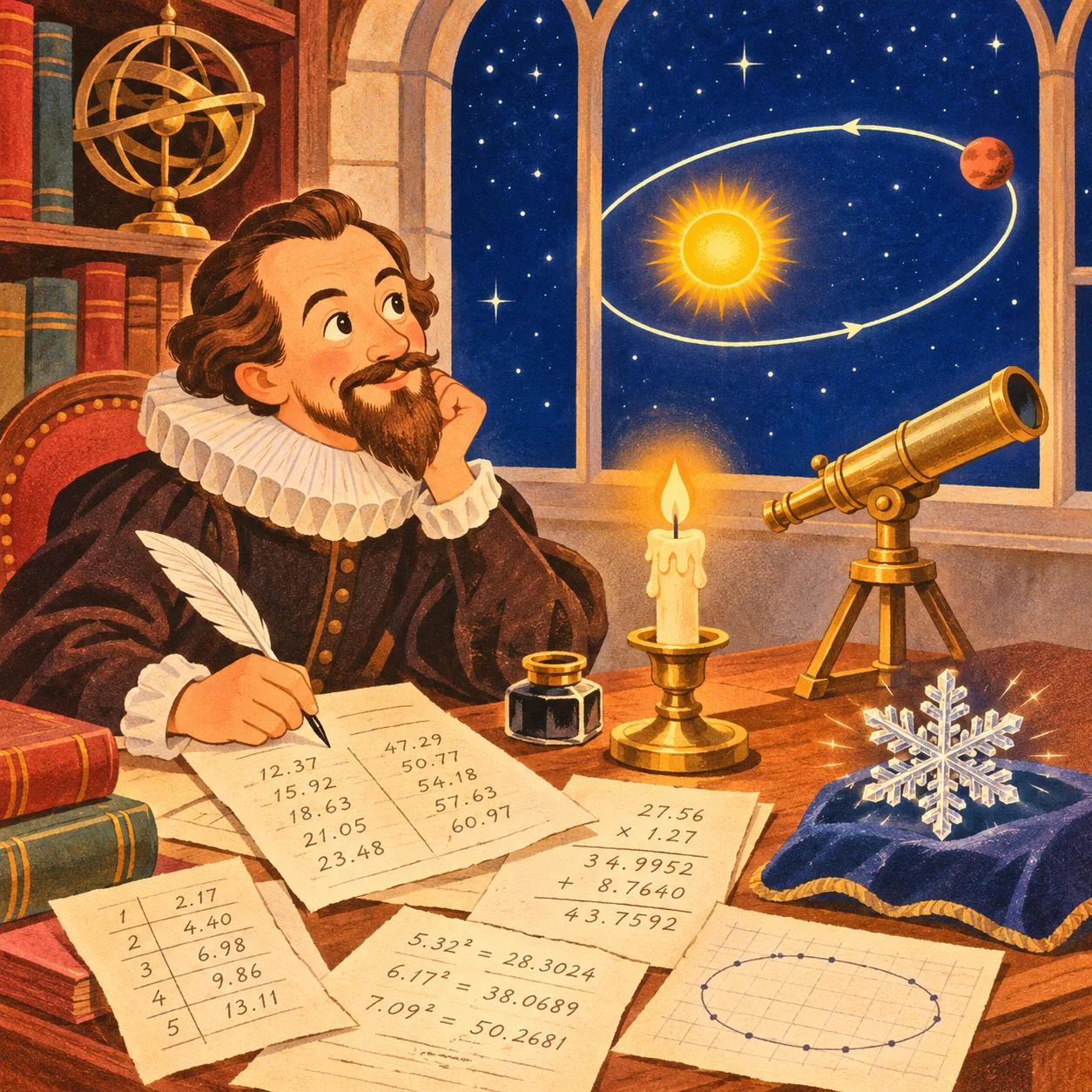
For about 2,000 years, astronomers had believed that planets must move in perfect circles. Kepler tried circle after circle for Mars, but none of them fit Tycho’s measurements. Some were off by only a tiny amount, but Kepler trusted Tycho’s numbers too much to ignore it.
After years of long calculations by hand, he found the answer. Mars does not travel in a circle at all. Its path is an ellipse, a slightly squashed circle, with the Sun not in the middle but a little to one side. In 1609 he published this in a book called New Astronomy.
Kepler’s Three Laws of Planetary Motion
- Every planet moves around the Sun in an ellipse, an oval path, with the Sun a little off center.
- A planet speeds up when it is closer to the Sun and slows down when it is farther away. A line from the planet to the Sun sweeps out equal areas in equal times.
- Planets farther from the Sun take much longer to go around it. Kepler found an exact math rule that links a planet’s distance from the Sun to the length of its year. He published this third law in 1619.
Kepler and Galileo
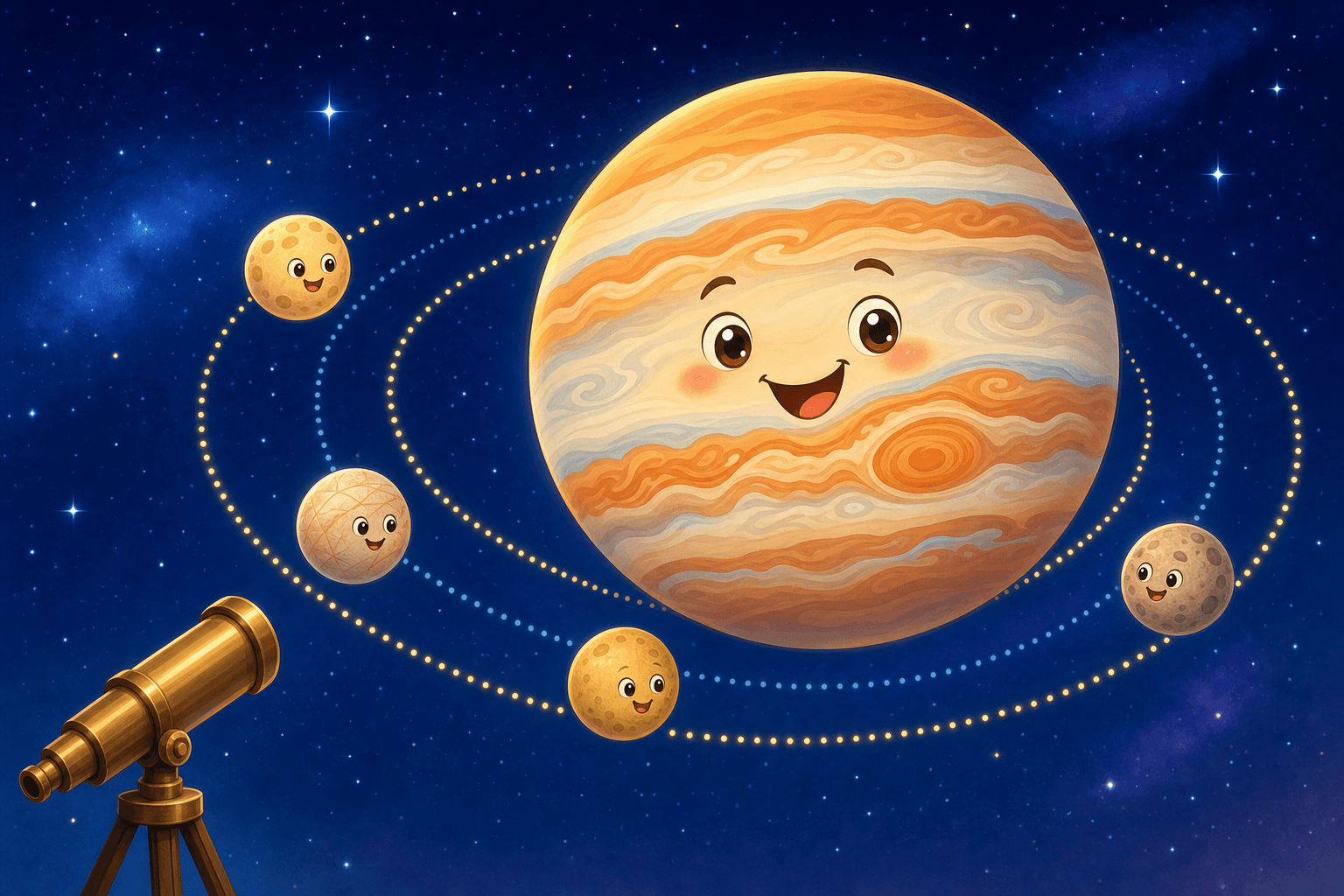
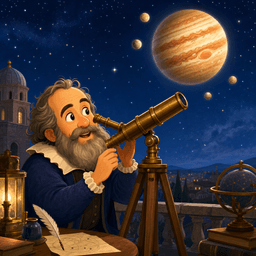
In 1610, the Italian scientist Galileo Galilei announced that he had used a telescope to see four moons going around Jupiter. Many people doubted him. Kepler quickly wrote a public letter supporting Galileo’s discoveries.
Kepler was also the first to use the word satellite for the moons of Jupiter, in 1611. Today we use it for every moon and every spacecraft that orbits a planet.
Light, Eyes and Telescopes
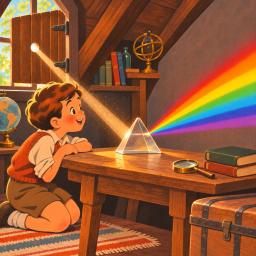
Kepler was fascinated by light. In a book from 1604, he explained how our eyes work. He showed that light passes through the front of the eye and makes a picture on the back, on a layer called the retina, and that the picture is upside down. He also explained how glasses help people see better.
In 1611 he described a new kind of telescope made with two curved lenses that bulge outward. It shows the sky upside down, but it gives a much wider view than Galileo’s design, which is why astronomers came to prefer it.
Hard Times
Kepler’s life was often difficult. In 1611 his first wife, Barbara, died, and so did one of their young sons. Kepler moved to Linz, in Austria, and in 1613 he married again, to Susanna.
Then, in 1615, his elderly mother, Katharina, was accused of being a witch. In 1620 she was arrested and locked up. Kepler put his work aside and defended her himself. After more than a year in prison, she was set free in October 1621.
His Last Years
In 1627 Kepler finished the Rudolphine Tables, named after Emperor Rudolf II. They used Tycho’s measurements and Kepler’s laws to predict where the planets would be in the sky, far better than older tables could.
Kepler died on November 15, 1630, in the city of Regensburg, aged 58. His grave was destroyed during a long war, but the words he wrote for it survived: I measured the skies, now the shadows I measure.
Fun Facts About Johannes Kepler
He wrote a little book about snowflakes.
In 1611 he gave a friend a New Year’s gift: a short essay asking why every snowflake has six sides. Scientists see it as one of the first studies of crystals.
He wrote one of the first science fiction stories.
His story, called The Dream, describes a journey to the Moon and what the sky would look like from there. It was published in 1634, four years after he died.
A star explosion is named after him.
In 1604 a bright new star appeared in the sky, and Kepler studied it for months. It was an exploding star, and today it is called Kepler’s Supernova.
He did all his math by hand.
He had no calculator or computer. Working out the orbit of Mars took him years of page after page of calculations.
Questions kids ask
What is Johannes Kepler famous for?
He discovered that planets travel around the Sun in ellipses, not circles, and he worked out three laws that describe how planets move. These are called Kepler’s laws of planetary motion.
What are Kepler’s three laws in simple words?
First, planets move in oval paths around the Sun. Second, a planet moves faster when it is closer to the Sun. Third, planets that are farther away take longer to go around the Sun, following an exact math rule.
Did Kepler and Galileo know each other?
They never met, but they wrote to each other. Kepler publicly supported Galileo when Galileo announced the moons of Jupiter in 1610.
Did Johannes Kepler have children?
Yes. He had children with both of his wives. Like many families at that time, the Keplers lost several children when they were young.
Why His Work Still Matters
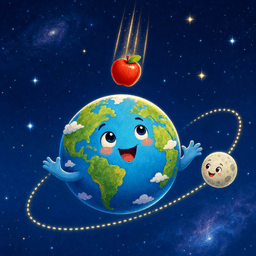
Kepler showed how the planets move, but he could not fully explain why. Less than 60 years after his death, in 1687, Isaac Newton used Kepler’s laws to work out the law of gravity. The same pull that makes an apple fall keeps the planets on their oval paths.
Today, space engineers still use Kepler’s laws to plan the paths of satellites and spacecraft. When a space probe coasts between the planets, its path follows the rules Kepler found by studying Mars.
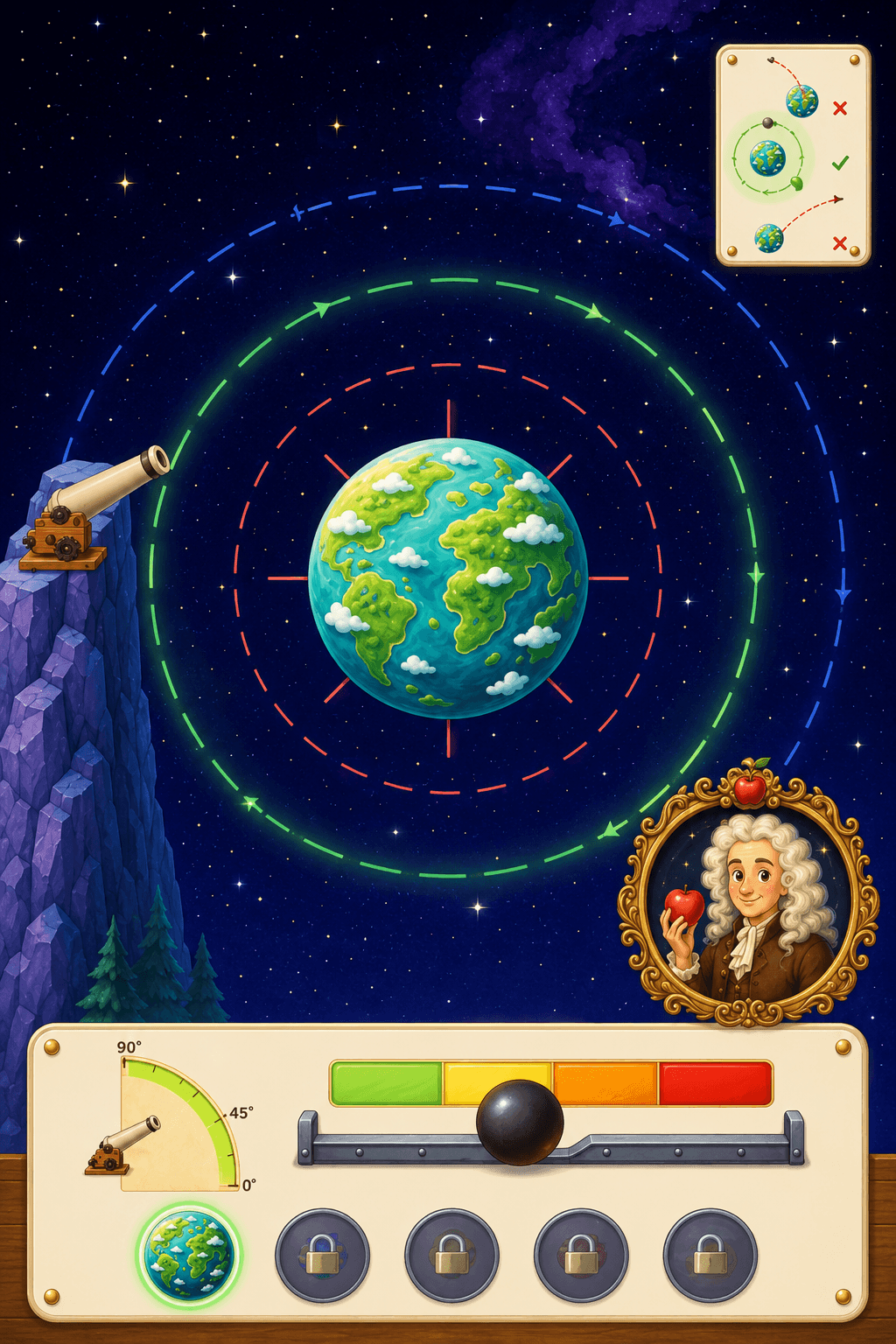
Newton's Orbit Cannon
Kepler found the paths the planets follow, and Newton explained them with gravity. Fire the cannon, bend the path with gravity and launch things into orbit!