The Moon Landing for Kids
In July 1969, two people stepped onto another world for the very first time. Here’s how Apollo 11 did it, one step at a time.
What was Apollo 11?
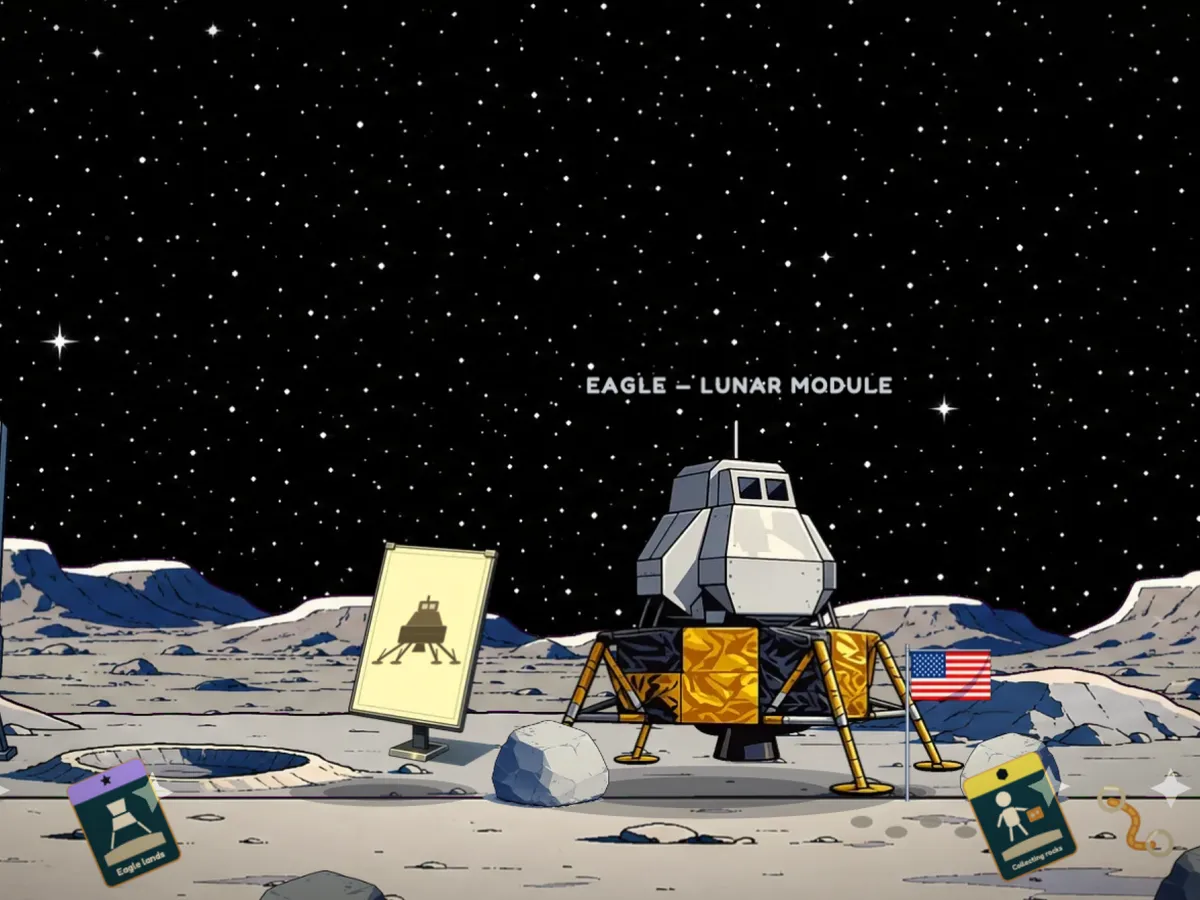
Apollo 11 was the space mission that first landed people on the Moon. It launched from Florida on 16 July 1969. Four days later, on 20 July 1969, the lunar module *Eagle* landed on a flat, dusty plain called the Sea of Tranquility.
Three astronauts went: Neil Armstrong, Buzz Aldrin and Michael Collins. Armstrong and Aldrin climbed down the ladder and walked on the Moon. Collins flew the command module *Columbia* around the Moon alone, waiting to take them home. He never set foot on the Moon.
The mission, step by step
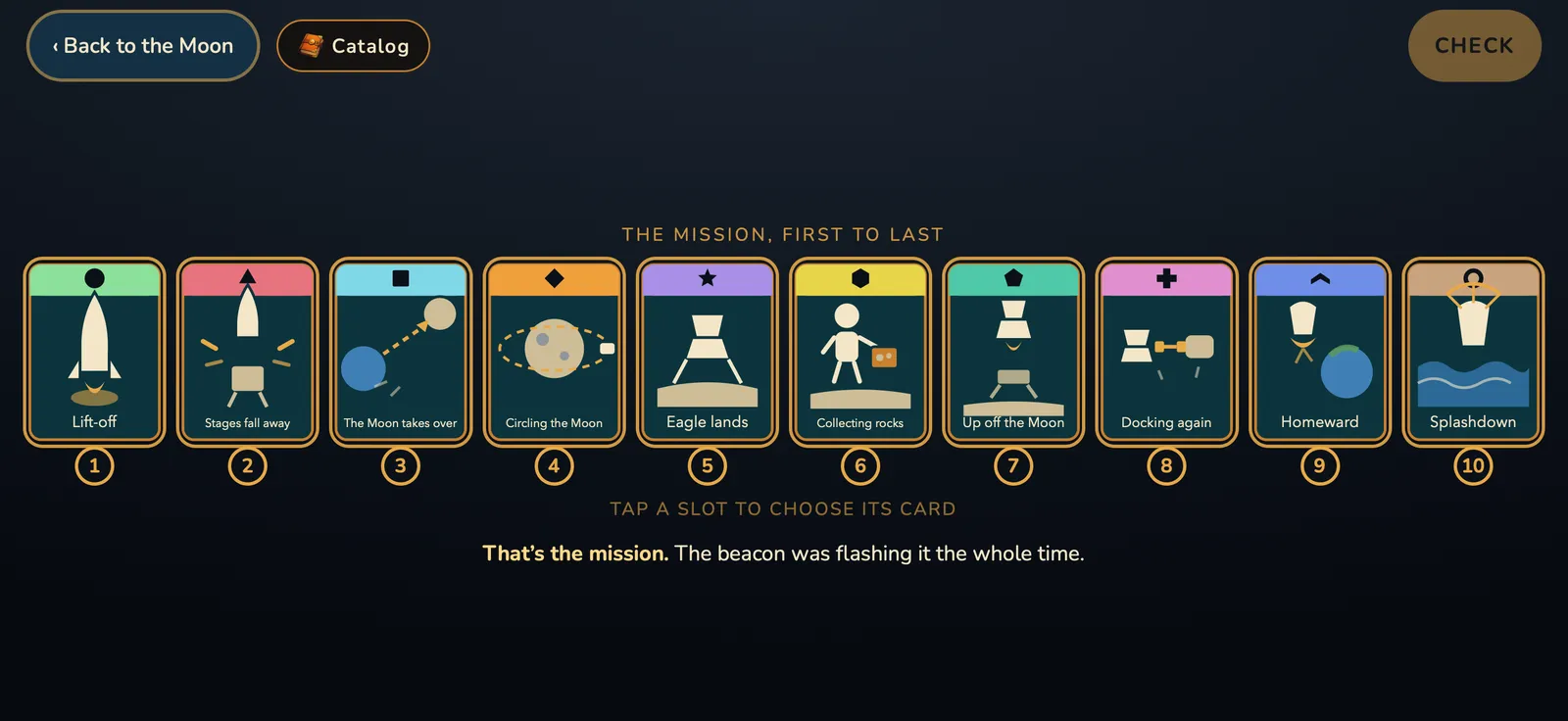
The game splits the flight into ten stages, just like these.
- 1
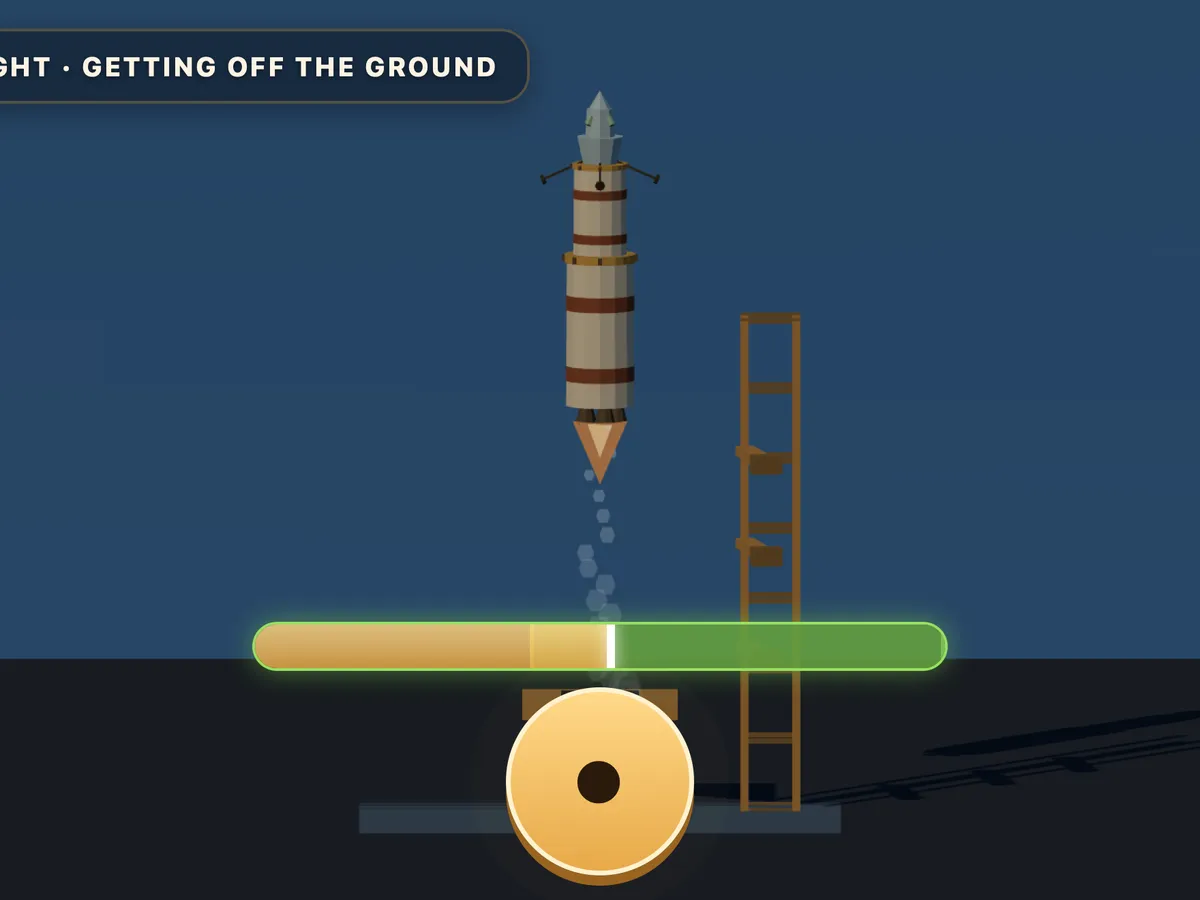
Lift-off
The giant Saturn V rocket, taller than a thirty-storey building, lifts Apollo 11 off the launch pad in Florida.
- 2
Stages fall away
Each rocket stage burns its fuel, lets go and falls back, so the part still flying keeps getting lighter.
- 3
The Moon takes over
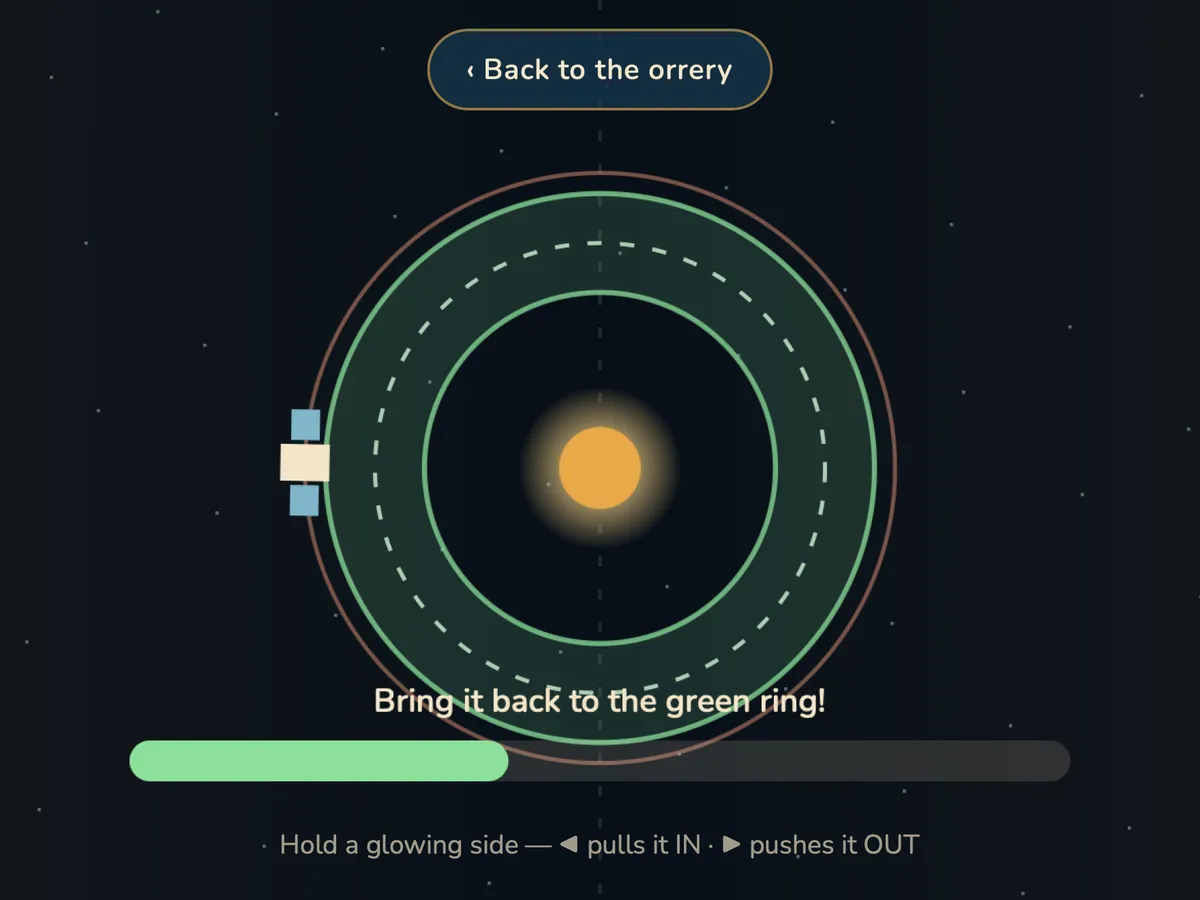
Most of the way there, Earth’s pull stops winning and the Moon’s pull takes over. Now they are falling toward the Moon.
- 4
Circling the Moon
The spacecraft slows just enough to be caught by the Moon’s gravity and goes into orbit around it.
- 5
Eagle lands
Armstrong flies Eagle past a field of boulders and lands with only seconds of fuel left.
- 6
Collecting rocks
The astronauts walk, take photos, set up experiments and scoop up about 21 kg of Moon rock and dust.
- 7
Up off the Moon
Only the top half of Eagle flies back up. The bottom half is left behind as a launch pad, and it is still there today.
- 8
Docking again
Eagle meets Columbia in orbit and the two lock together, so the crew can climb across with their Moon rocks.
- 9
Homeward
A rocket burn sends Columbia back toward Earth. Its heat shield glows white-hot as it rushes into the air.
- 10
Splashdown
Parachutes open and the capsule lands in the Pacific Ocean on 24 July 1969, where a ship picks up the crew.
Meet the lunar module, Eagle
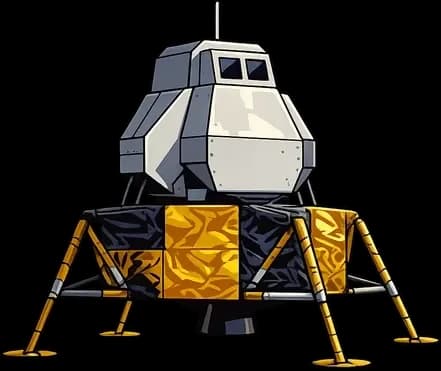
The lunar module was really two spacecraft stacked together. The bottom half had the landing legs and stayed on the Moon for good. The top half carried the astronauts back up.
Its shiny gold-coloured wrapping was insulation, about 25 thin layers, to protect it from the burning sunlight and freezing shadows of space.
What is it like on the Moon?
The Moon has no air. That means no wind, no weather and no sound. The sky stays black even in bright sunlight, and footprints left by the astronauts can last for a very long time, because there is no wind to blow them away.
Gravity on the Moon is about one-sixth of Earth’s, so the astronauts bounced and hopped as they moved. The flag needed a rod along its top edge to hold it out, because there is no breeze to make it fly.
Moon Mission Facts
Neil Armstrong’s first words are famous.
Stepping onto the Moon, he said: “That’s one small step for man, one giant leap for mankind.”
The Sea of Tranquility has no water.
Early astronomers thought the Moon’s dark patches were seas. They are actually flat plains of old, cooled lava.
Most of the Saturn V rocket was fuel.
It burned most of that fuel in just minutes to push the spacecraft away from Earth.
Scientists still study Apollo Moon rocks.
The rocks the astronauts brought back are still helping scientists learn how the Moon formed.
The Moon is about 384,000 km away.
That’s like going around the Earth almost ten times. Apollo 11 took about four days to get there.
Science words to know
- Lunar
- To do with the Moon.
- Lunar module
- The spacecraft that carried two astronauts down to the Moon and back up.
- Command module
- The capsule, Columbia, that circled the Moon and brought the crew home.
- Splashdown
- When a space capsule lands in the ocean.
Quick quiz!
0 / 31. Which Apollo 11 astronaut did NOT walk on the Moon?
2. What was the name of the lunar module?
3. Why is the sky on the Moon black, even in daytime?
Questions kids ask
Who was the first person to walk on the Moon?
Neil Armstrong, on 20 July 1969 (21 July in some time zones). Buzz Aldrin followed him down the ladder about 20 minutes later.
How many people have walked on the Moon?
Twelve, on six Apollo landings between 1969 and 1972. Nobody has landed there since.
How long did it take Apollo 11 to reach the Moon?
About four days. The whole mission, from launch to splashdown, lasted eight days.
How did the rocket get to the Moon?
By dropping empty stages to get lighter, then coasting until the Moon’s gravity took over. Learn more in how do rockets work.
Landing Sequence
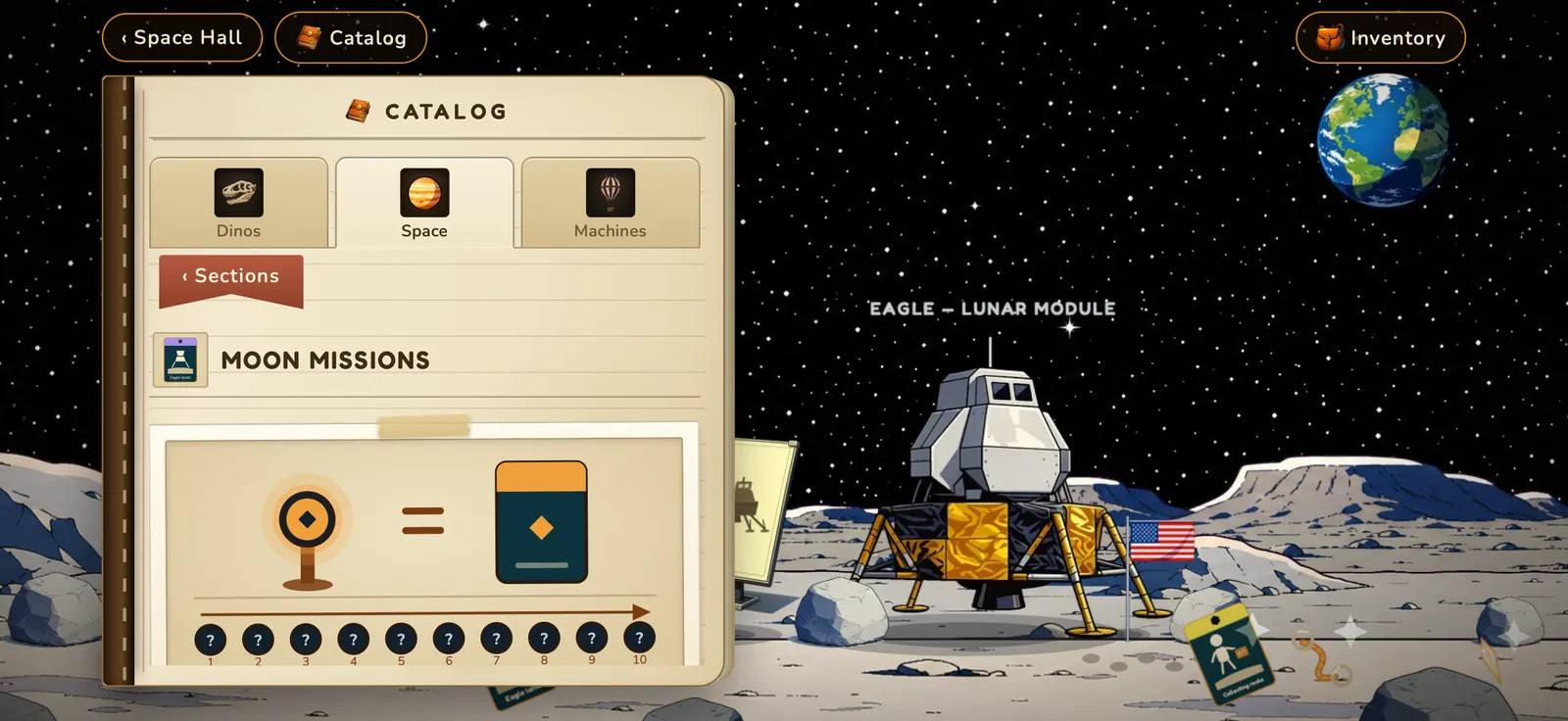
Find all ten mission cards scattered around the Space Wing, then put Apollo 11 back in order. A flashing beacon holds the secret.
No ads, ever · Plays offline · Made for young kids and adults