How Do Fossils Form?
A dinosaur bone can turn into stone and wait millions of years for someone to find it. Here’s how it happens, step by step.
What is a fossil?
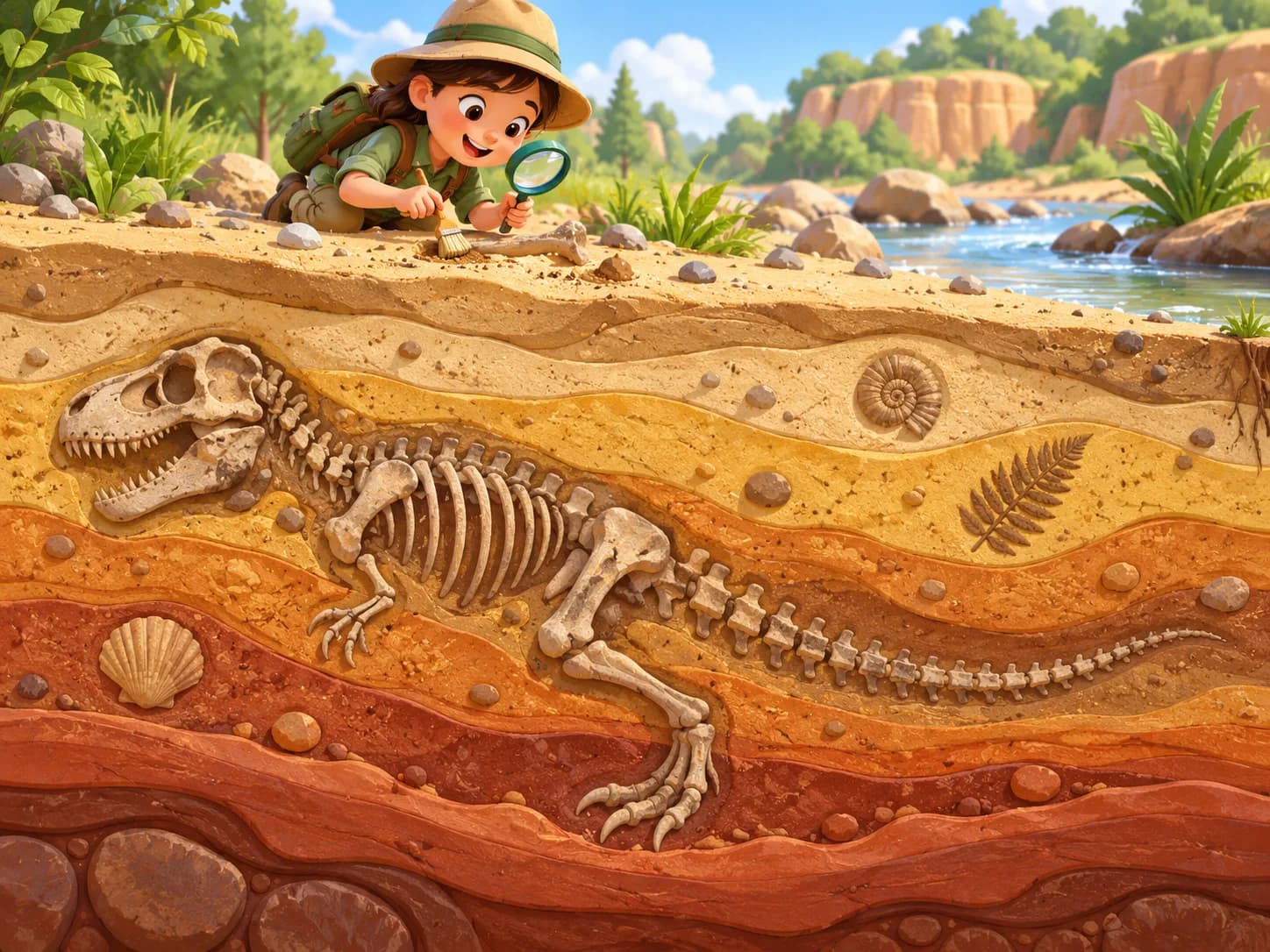
A fossil is the remains or traces of a living thing from long ago, kept safe in rock. The word comes from a Latin word that means “dug up”. Fossils can be bones, teeth, shells, leaves, footprints and even poo!
Scientists sort them into two groups. Body fossils are parts of the living thing itself, like bones, teeth and shells. Trace fossils are signs of what it did, like footprints, nests and burrows. You can read all about tracks in dinosaur footprints.
How a dinosaur becomes a fossil
It only works if everything goes just right.
- 1
The dinosaur dies
The best place is near a river, lake or sea, where mud and sand pile up fast.
- 2
The soft parts disappear
Skin and muscle rot away or get eaten by scavengers. The hard bones and teeth are left behind.
- 3
Mud and sand bury it
Layers of mud, sand or silt cover the bones. This keeps out scavengers, weather and most of the air.
- 4
The layers turn to rock
More and more layers pile on top. Their weight squeezes the lower layers until they harden into rock.
- 5
Bone turns to stone
Water seeps through the rock and into tiny holes in the bones. It leaves minerals behind, which slowly turn the bones to stone.
- 6
The fossil comes back
Millions of years later, moving land pushes the rock up, and wind and rain wear it away until the fossil peeks out.
Different kinds of fossils
Not every fossil is a stone bone. Here are five ways living things get saved in rock.
Mineral bones
Minerals fill the holes in a bone and turn it to stone. This is the most common way a dinosaur becomes a fossil.
Moulds
The buried bone or shell dissolves away and leaves a hollow in the rock, in exactly its shape.
Casts
Minerals or mud fill a mould and set hard, making a stone copy of the original.
Trace fossils
Footprints, burrows, nests and fossil poo show what an animal did.
Read more →Amber
Tiny creatures trapped in sticky tree resin, which hardened like golden glass.
Why are fossils so rare?
Most living things never become fossils. When an animal dies, it usually gets eaten, rots away or is scattered long before mud can cover it. To become a fossil it has to be buried quickly, and then the rock around it has to last for millions of years.
That is why sea creatures make up almost all fossils. On the seabed, shells and bones are covered by sand and mud very quickly. A dinosaur on dry land had a much smaller chance, unless it died near a river or lake. So every dinosaur skeleton in a museum is a very lucky find, like the famous T. rex skeletons.
How old is a fossil?
Rock layers stack up like pages in a pile of newspapers, with the oldest at the bottom and the newest on top. So a fossil deep down is usually older than one near the top.
To put a real number on it, scientists look for layers of volcanic ash above and below the fossil. Ash contains tiny crystals with radioactive atoms that change at a steady rate, like a ticking clock. By measuring them, scientists can work out the age of each ash layer, and so how old the fossil between them must be.
How paleontologists dig up a dinosaur
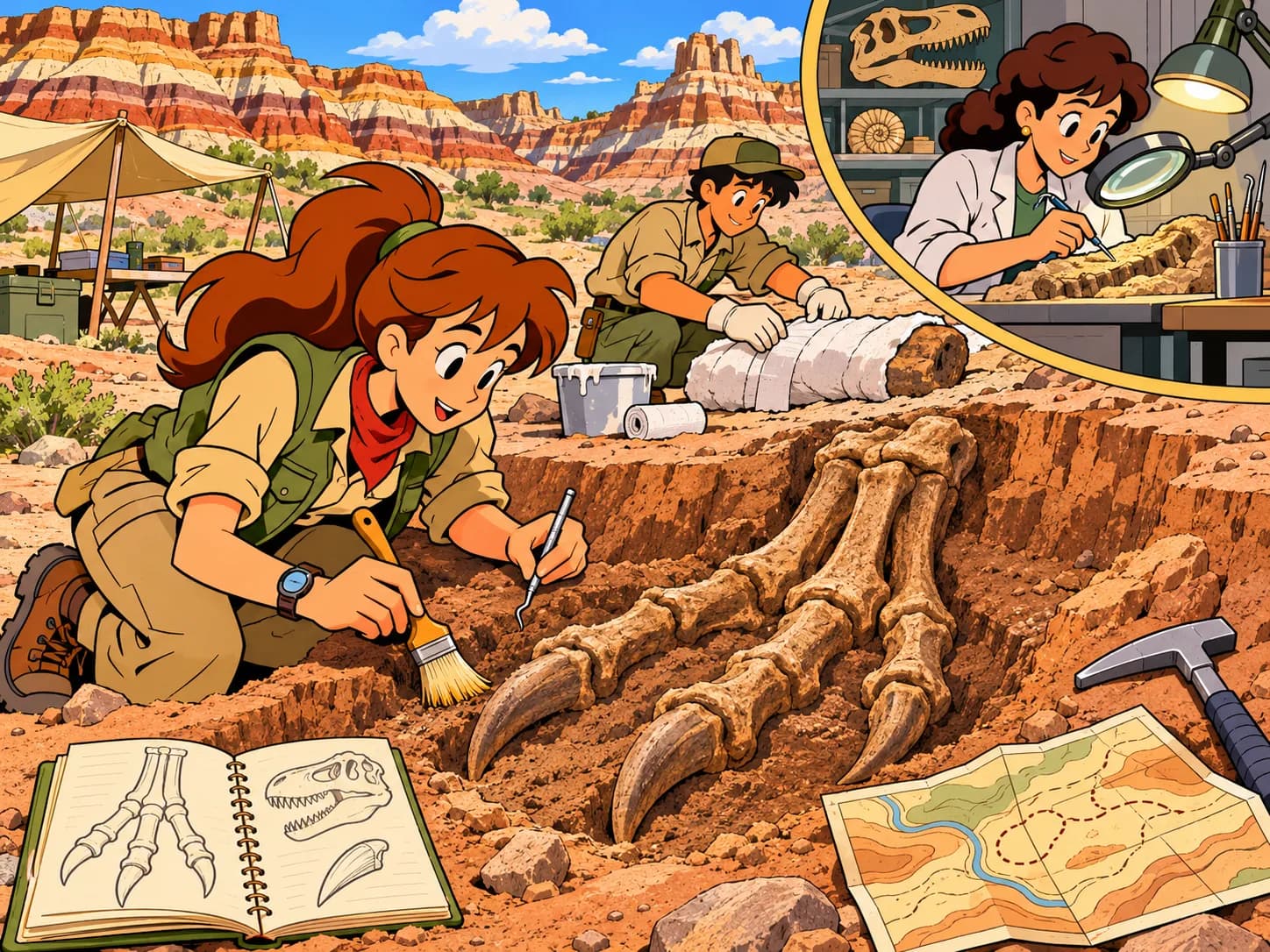
- They chip away the rock around a bone with small picks and brushes, until the bone sits on a little stand of rock.
- They cover the bone with paper, then wrap it in strips of cloth soaked in plaster, like a cast for a broken arm.
- The hard plaster jacket protects the bone on its trip to the museum. Big jackets can be so heavy that a helicopter has to lift them.
- In the lab, experts remove the last bits of rock with tiny drills, needles and brushes. This can take much longer than the dig.
Fantastic Fossil Facts
The most complete T. rex is called SUE.
It is named after Sue Hendrickson, who found it in South Dakota in 1990. SUE has about 250 of a T. rex’s roughly 380 bones, and lives at the Field Museum in Chicago.
A young girl helped find a famous fossil.
In 1811, when Mary Anning was 12, her brother found a strange skull near Lyme Regis, England. About a year later, Mary dug out the rest of the skeleton. It was an ichthyosaur, a sea reptile.
Almost all fossils come from the sea.
Around 99 percent of fossils are sea animals, like shellfish and sharks, because sand and mud bury them so quickly.
Some fossils are frozen, not stone.
A baby mammoth called Lyuba lay frozen in the ground in Siberia for about 42,000 years, until she was found in 2007. Ice, volcanic ash and amber can even save soft parts.
Even poo can become a fossil.
Fossil poo is called a coprolite, and it can show what an animal ate. Find out more in what did dinosaurs eat.
Science words to know
- Fossil
- The remains or traces of a living thing from long ago, preserved in rock.
- Sediment
- Bits of mud, sand and silt that settle in layers.
- Sedimentary rock
- Rock made from layers of sediment pressed together. This is where most fossils are found.
- Trace fossil
- A sign of what an animal did, like a footprint, burrow or nest.
- Paleontologist
- A scientist who studies fossils to learn about ancient life.
Quick quiz!
0 / 31. What has to happen soon after a dinosaur dies for it to become a fossil?
2. Which of these is a trace fossil?
3. How do scientists work out how old a dinosaur fossil is?
Questions kids ask
How do fossils form?
Most fossils form when a living thing is buried quickly by mud or sand. Over millions of years the layers turn to rock, and minerals carried by water slowly turn bones and shells into stone.
How long does it take for a fossil to form?
Thousands or even millions of years. Most dinosaur fossils are more than 66 million years old, because that is when most dinosaurs died out.
What are the main types of fossils?
Body fossils, like bones, teeth and shells, and trace fossils, like footprints, nests and fossil poo. Moulds, casts and amber are other ways living things get preserved.
Where are fossils found?
In sedimentary rock, like sandstone and limestone, often where rain, rivers or the sea have worn the rock away. Dinosaur fossils have been found on every continent, even Antarctica. Meet the museum’s five animals in dinosaur facts for kids.
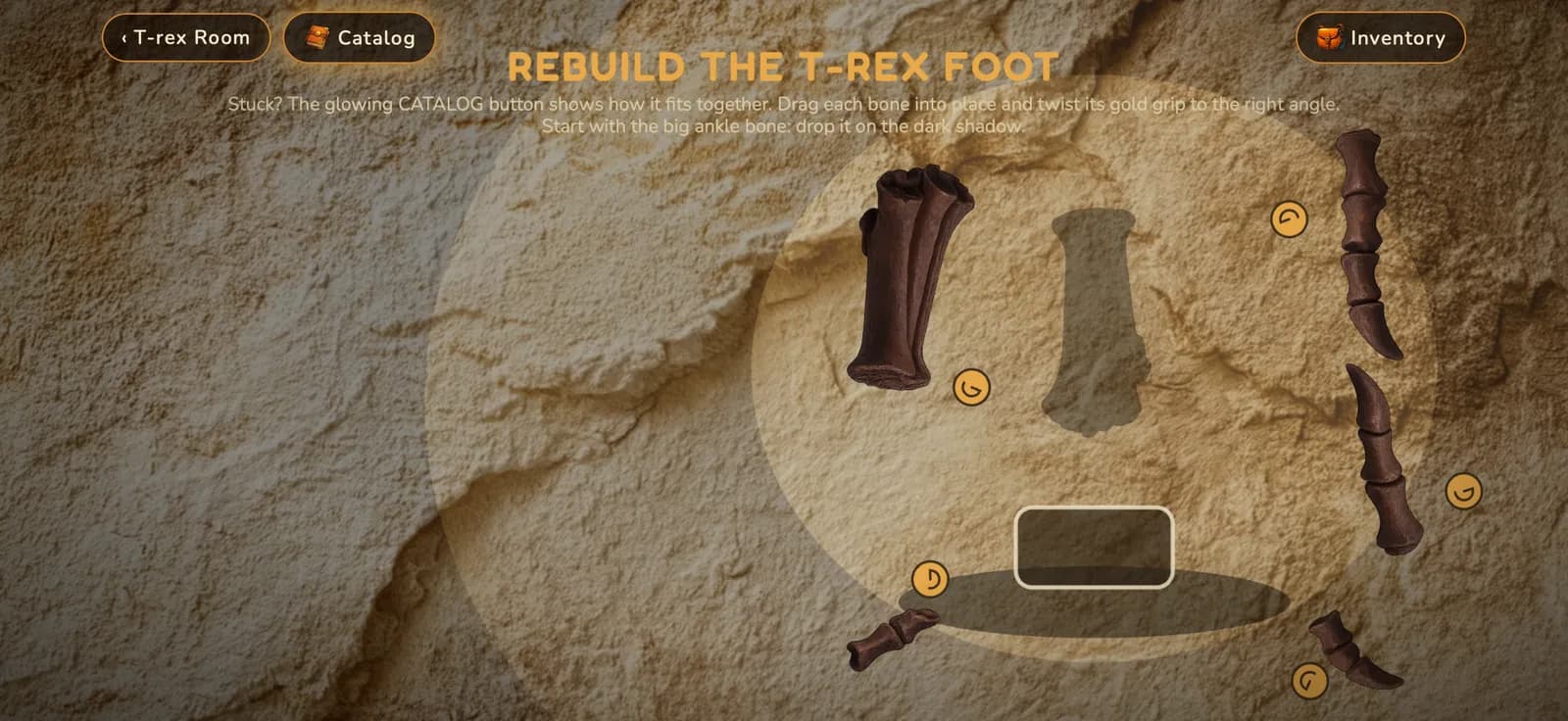
The Dinosaur Wing
Rebuild a fossil T. rex foot bone by bone, find the fossil hidden in each room and use the Field Guide to work out which animal it belongs to.
✔ The whole Dinosaur Wing is free to play
No ads, ever · Plays offline · Made for young kids and adults