The Hubble Space Telescope for Kids
A telescope as long as a school bus that has circled Earth since 1990, sending back some of the most famous space pictures ever taken.
What is the Hubble Space Telescope?
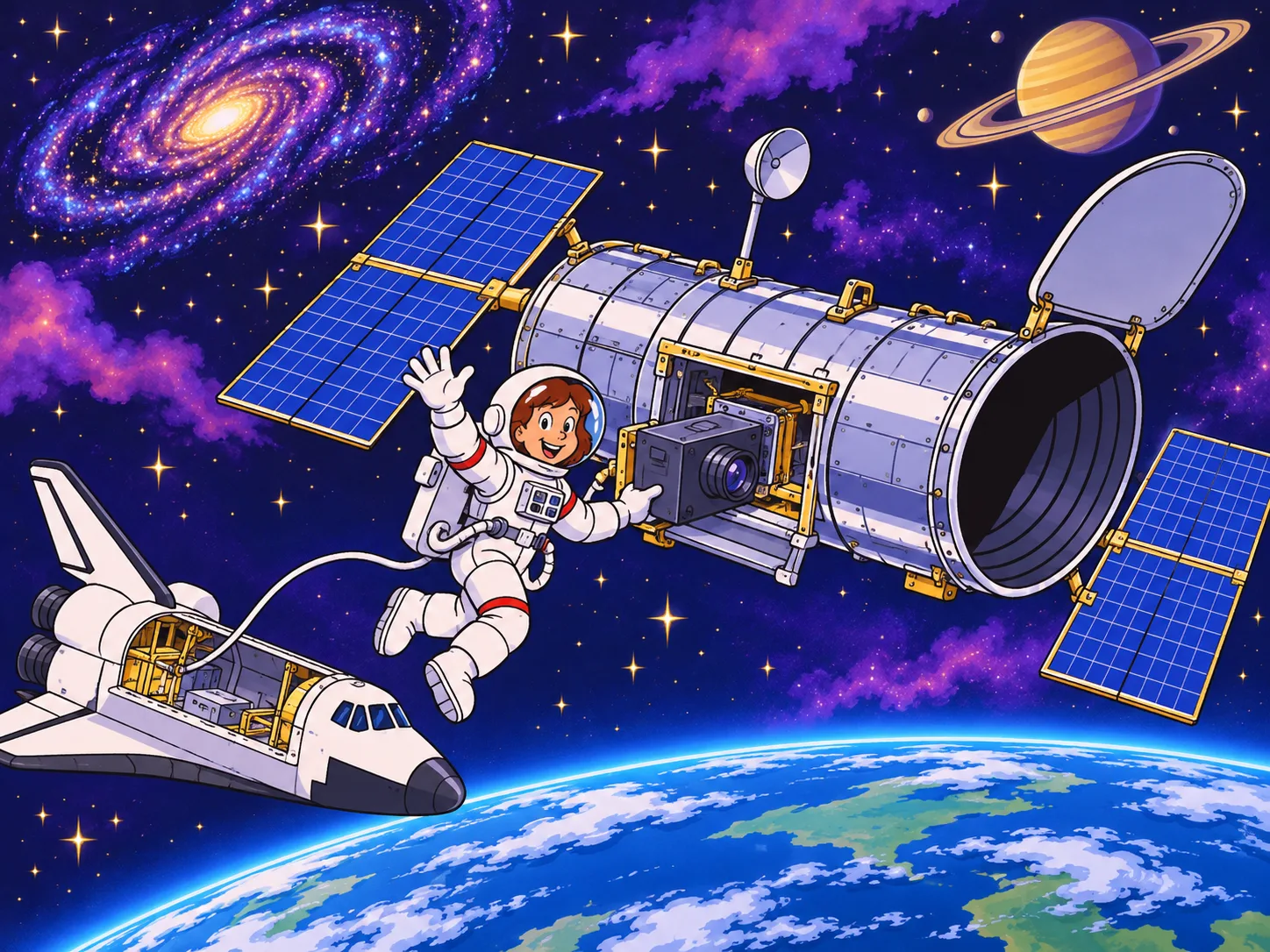
The Hubble Space Telescope is a big telescope that circles the Earth, high above the air. NASA launched it on 24 April 1990, tucked inside the cargo bay of the Space Shuttle Discovery, and the astronauts set it free in space the next day. Hubble was built by NASA, working together with the European Space Agency.
Hubble is named after Edwin Hubble, an American astronomer. In the 1920s he showed that many fuzzy patches in the sky are really other galaxies, far beyond our own Milky Way. He also found that those galaxies are moving away from us, which means the universe is growing.
Why put a telescope in space?
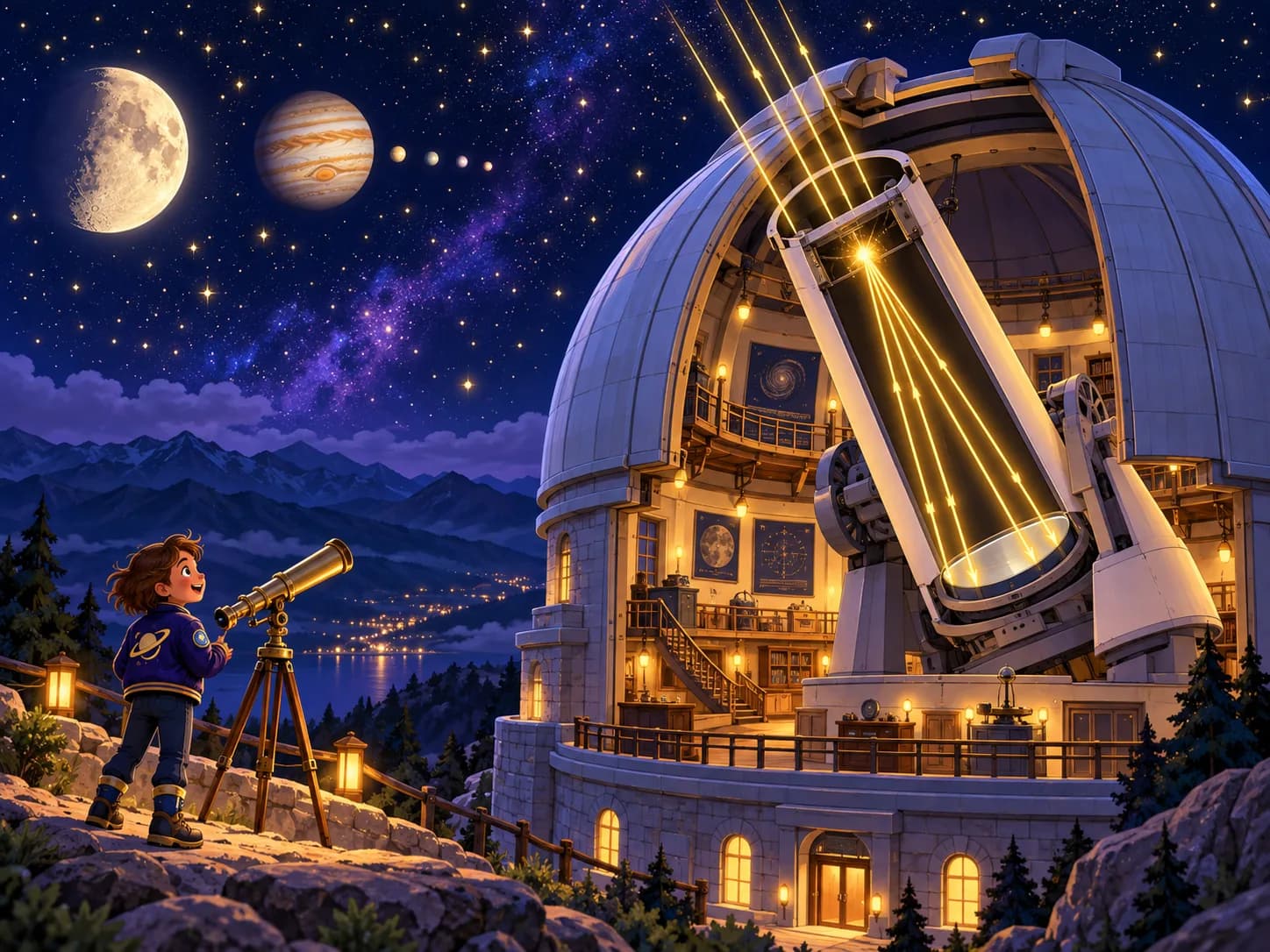
On the ground, starlight has to pass through Earth’s air before it reaches a telescope. The air is always moving, and it wobbles the light. That wobble is what makes stars twinkle, and it blurs a telescope’s view. The air also blocks most ultraviolet light, a kind of light our eyes can’t see.
Up in space, Hubble is above all of that, so its pictures are sharp and clear. It sees the light our eyes can see, plus some ultraviolet and some infrared light. Find out more about how telescopes work.
📏 How big is Hubble?
- Hubble (length)13.2 m, as long as a big school bus
- Hubble’s main mirror2.4 m across
- A doorabout 2 m
- A 10-year-oldabout 1.4 m
How Hubble takes a picture
Every Hubble picture goes through the same four steps.
- 1
Point and hold still
Spinning wheels inside Hubble slowly turn it to face its target. Sensors then help it lock on and hold very, very still.
- 2
Catch the light
Light from space bounces off the 2.4-metre main mirror onto a smaller mirror, which sends it to Hubble’s cameras and other instruments.
- 3
Take the picture
Hubble’s digital cameras collect the light. For very faint things, they keep collecting for a long time, sometimes many hours, to build up a picture.
- 4
Send it home
Hubble sends its pictures to Earth as radio signals, passed along by other satellites. Scientists then turn the data into the images we see.
Hubble needed glasses
Soon after launch, scientists found a big problem. Hubble’s pictures were blurry. Its main mirror had been made in slightly the wrong shape. It was too flat near the edge by a tiny amount, about one fiftieth of the thickness of a sheet of paper.
In December 1993, astronauts flew to Hubble on the Space Shuttle Endeavour. They put in small mirrors that corrected the view, a bit like a pair of glasses, and a new main camera with its own correction built in. After that, Hubble’s pictures were sharp.
Astronauts as space mechanics
Hubble was designed so that astronauts could fix and upgrade it in space. Space shuttle crews visited it five times, in 1993, 1997, 1999, 2002 and 2009. They caught it with the shuttle’s robot arm, then went on spacewalks to replace broken parts and fit new cameras, computers and solar panels.
The last visit was in 2009, and the space shuttles stopped flying in 2011. Since then Hubble has kept working on its own. In 2024, one of its gyroscopes, the sensors that help it point steadily, kept giving bad readings, so engineers changed Hubble to work with just one gyroscope. Even after more than 35 years in space, it is still making discoveries.
What has Hubble discovered?
Hubble has looked at everything from nearby planets to galaxies near the edge of what we can see.
Galaxies everywhere
In December 1995, Hubble stared at a tiny, dark-looking patch of sky for ten days. The picture, called the Hubble Deep Field, was full of galaxies, well over a thousand of them.
The age of the universe
Hubble’s measurements helped scientists work out that the universe is almost 14 billion years old.
A comet hits Jupiter
In July 1994, Hubble watched pieces of Comet Shoemaker-Levy 9 crash into Jupiter, leaving dark marks in its clouds.
New moons for Pluto
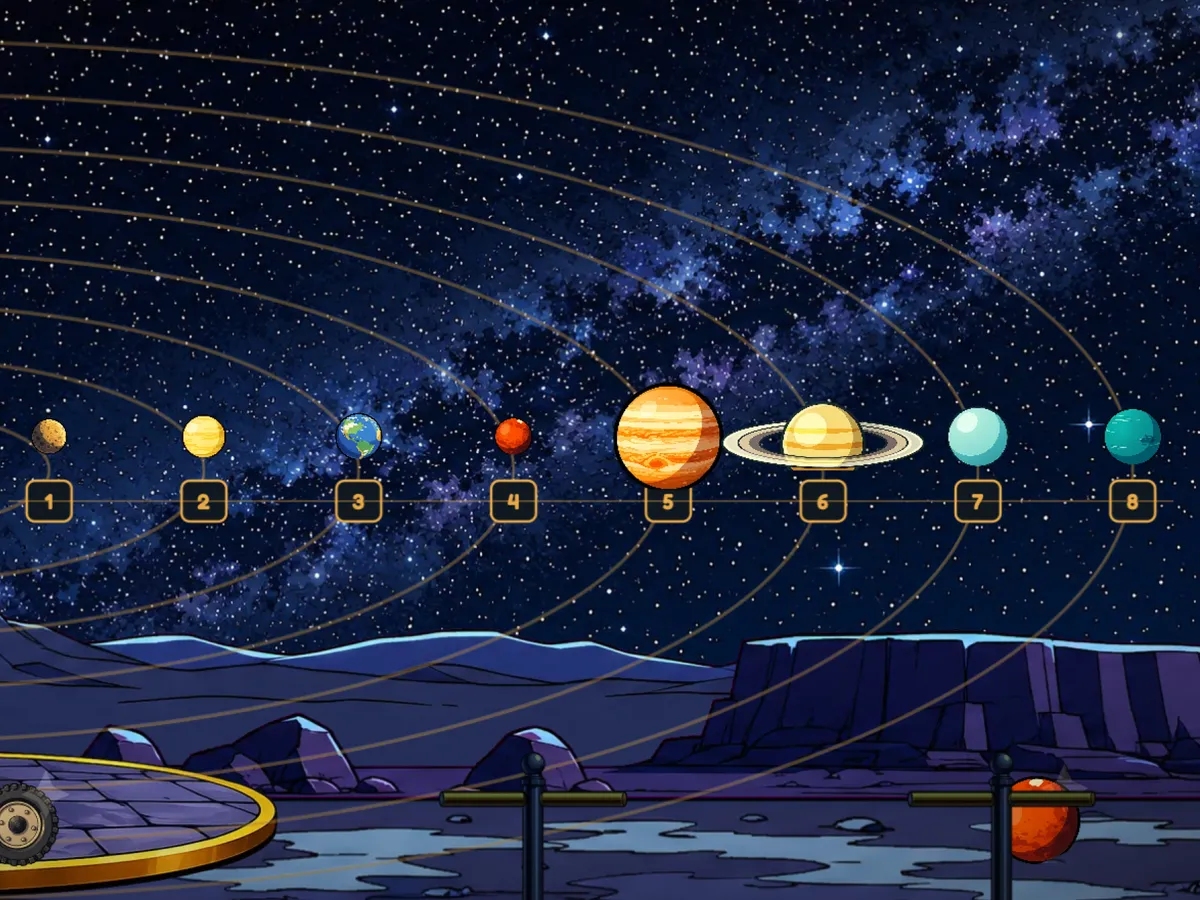
Hubble found four small moons around Pluto: Nix and Hydra in 2005, Kerberos in 2011 and Styx in 2012. Meet the planets in the solar system for kids.
Pillars of Creation
In 1995, Hubble photographed giant towers of gas and dust where new stars are being born. The picture became one of the most famous space photos ever.
Giant black holes
Hubble helped show that most big galaxies have a giant black hole at their centre, millions or even billions of times heavier than the Sun.
Hubble and Webb, a space team
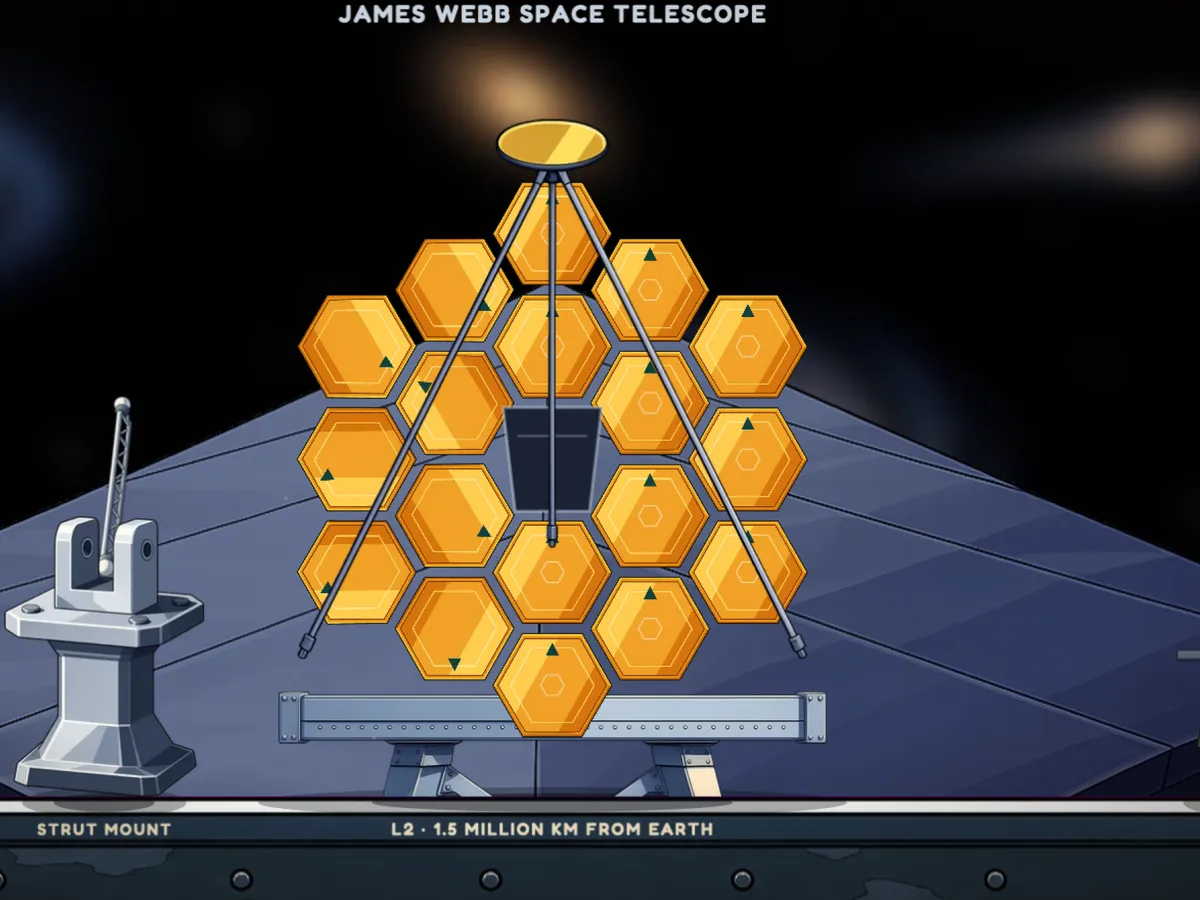
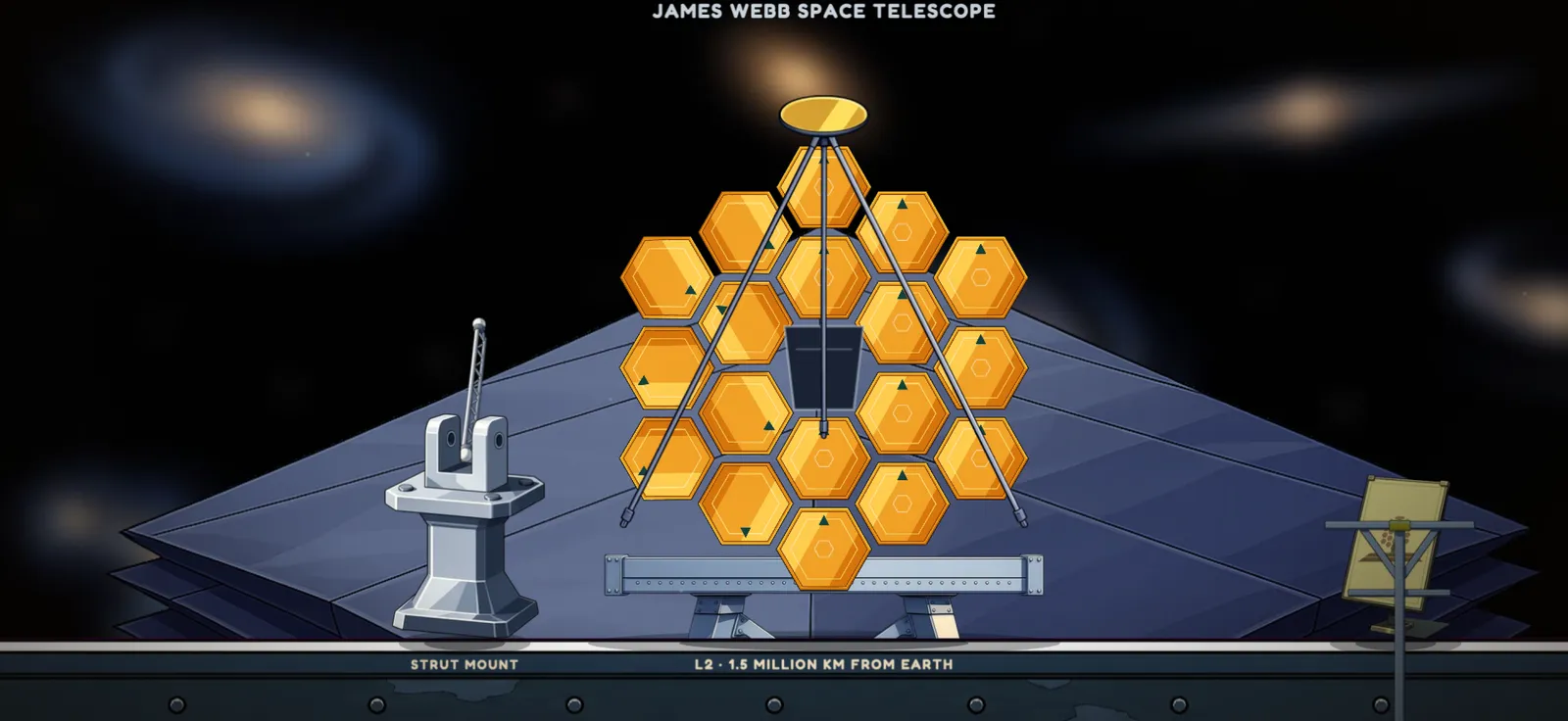
In 2021, a new giant telescope joined Hubble in space: the James Webb Space Telescope. Webb’s golden mirror is much bigger, 6.5 metres across, and it mainly sees infrared light. Hubble sees mostly visible and ultraviolet light.
They are partners, not rivals. The two telescopes often look at the same galaxies and star clouds, and together they show more than either one could alone.
Hubble Fun Facts
Hubble weighs about as much as two elephants.
It weighed about 11,000 kilograms at launch, roughly as much as two adult elephants.
It goes around Earth about 15 times a day.
One trip around the planet takes about 95 minutes, so Hubble passes from day to night and back again about 15 times every day.
Hubble never looks at the Sun.
The Sun is far too bright and could damage its cameras. That is also why Hubble has never taken a picture of Mercury, the planet closest to the Sun.
It has made over a million observations.
By 2025, Hubble had made nearly 1.7 million observations of about 55,000 things in space, and scientists had written more than 22,000 science papers using its data.
It runs on sunshine.
Two big solar panels turn sunlight into electricity. Batteries keep Hubble going when it passes through Earth’s shadow.
Science words to know
- Space telescope
- A telescope sent into space, above Earth’s air.
- Orbit
- The curved path one object takes around another, like Hubble around Earth.
- Galaxy
- A huge group of stars, gas and dust, like our Milky Way.
- Ultraviolet
- A kind of light our eyes can’t see. It is what gives you sunburn.
- Gyroscope
- A sensor that measures how a spacecraft is turning, which helps it point and hold steady.
Quick quiz!
0 / 31. Who is the Hubble Space Telescope named after?
2. Why were Hubble’s first pictures blurry?
3. How did astronauts reach Hubble to repair it?
Questions kids ask
What is the Hubble Space Telescope used for?
Astronomers use it to take sharp pictures and measurements of planets, stars, galaxies and clouds of gas in space. It has helped answer big questions, like how old the universe is.
How far away is Hubble from Earth?
It circles a little less than 500 kilometres (about 290 miles) above the ground, much closer than the Moon, and it is slowly sinking lower. The International Space Station flies a bit lower, at about 400 kilometres.
Is the Hubble telescope still working?
Yes. Hubble was launched in 1990 and is still doing science more than 35 years later.
What is the difference between Hubble and the James Webb Space Telescope?
Hubble circles Earth and sees mostly visible and ultraviolet light. Webb has a much bigger mirror, sits about 1.5 million kilometres away and sees mainly infrared light.
The Infrared Eye
Hubble’s golden partner lives in the museum’s Space Wing. Switch between your own eyes and infrared vision to find stars being born, hidden galaxies and Neptune’s secret rings.
No ads, ever · Plays offline · Made for young kids and adults