How Do Telescopes Work?
A telescope is a giant bucket for light. Here’s how lenses and mirrors catch starlight and make faraway worlds look close.
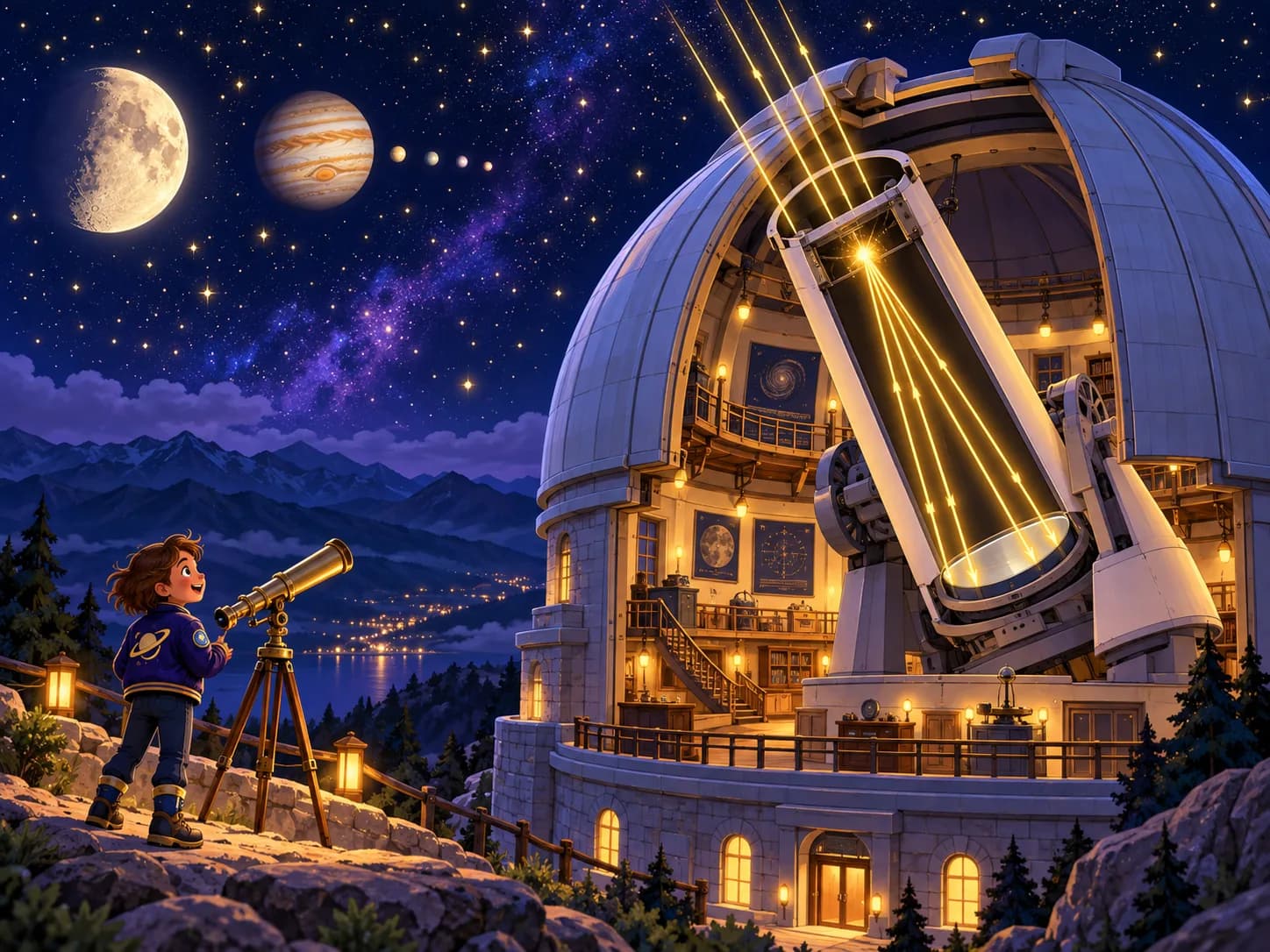
What is a telescope?
A telescope is a tool that helps us see things that are very far away. The name comes from two Greek words that mean “far” and “to look”, so a telescope is a far-looker.
Stars and planets are so far away that only a tiny trickle of their light reaches us. Your eye catches that light through your pupil, the black dot in the middle of your eye, which is only a few millimetres wide. A telescope works like a much bigger eye. It catches far more light than your eye can, then squeezes it into a small, bright picture.
How a telescope works, step by step
Telescopes that look at light we can see all do the same four jobs.
- 1
Light arrives
Light from a star or planet travels through space and reaches the telescope.
- 2
A big lens or mirror catches it
The front lens or main mirror is much wider than your eye, so it collects lots more light.
- 3
The light is brought together
The curved lens bends the light, or the curved mirror bounces it, so it all meets at one point, called the focus. A small, bright picture forms there.
- 4
The picture is made bigger
A small lens called the eyepiece magnifies the picture for your eye. Big observatories put a camera there instead.
Different kinds of telescopes
Telescopes catch light in different ways, and some catch kinds of light our eyes can’t see.
Refracting telescopes
These use curved glass lenses to bend light. The first telescopes were all this kind.
Reflecting telescopes
These use a curved mirror to bounce light to a focus. All of today’s giant telescopes are this kind.
Radio telescopes
Huge metal dishes that catch radio waves from space instead of the light we see.
Space telescopes
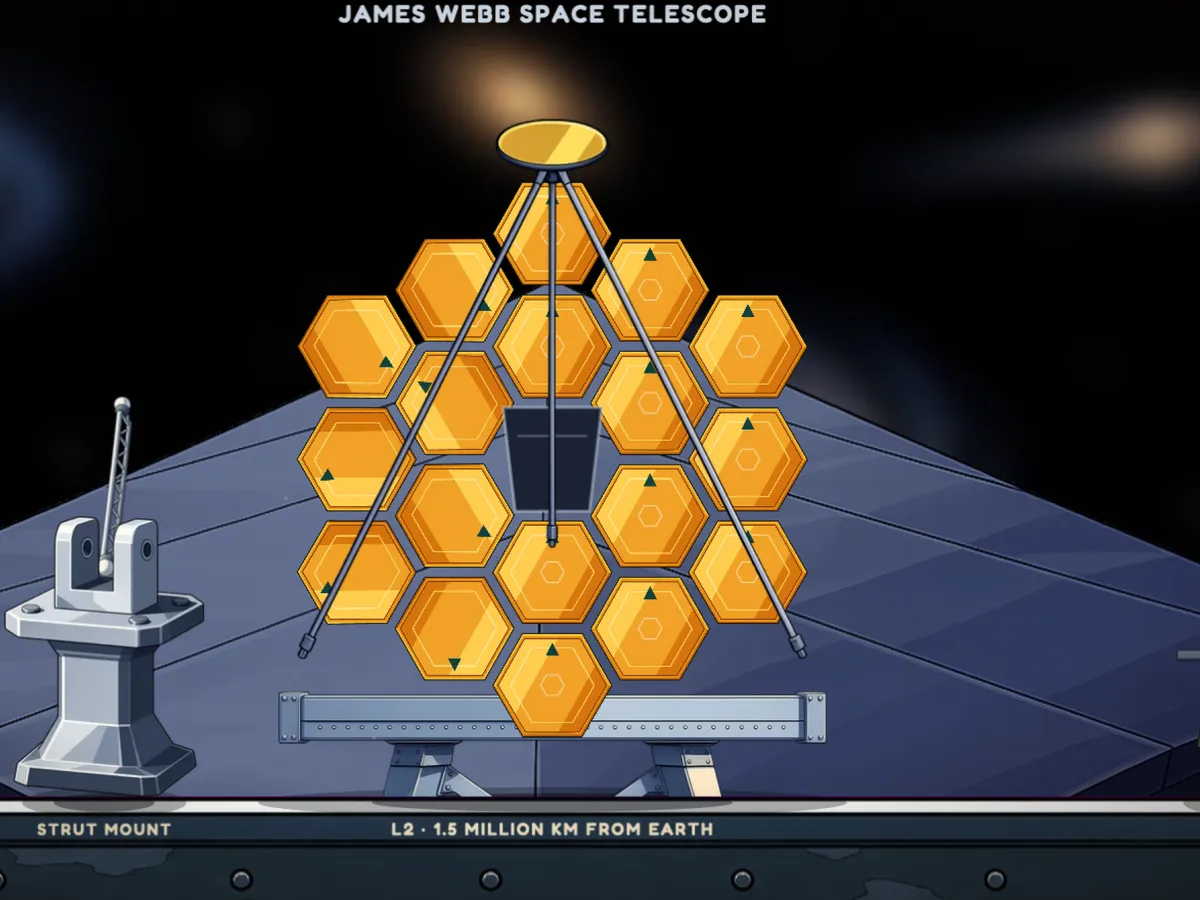
Telescopes sent above Earth’s air, like Hubble and the James Webb Space Telescope.
Why bigger is better
Astronomers care most about how wide a telescope’s main lens or mirror is, not how much it zooms. A wider mirror is like a wider bucket in the rain: it catches more. More light means a telescope can see fainter, more distant things, and show finer details.
That is why telescopes keep getting bigger. Hubble’s main mirror is 2.4 metres across. Webb’s is 6.5 metres. And in Chile, astronomers are building the Extremely Large Telescope, with a main mirror 39 metres wide. That is wider than a basketball court is long.
📏 How wide is the light catcher?
- Extremely Large Telescope39 m (being built)
- James Webb Space Telescope6.5 m
- Hubble Space Telescope2.4 m
- Your eye’s pupilabout 7 mm in the dark
Why do big telescopes use mirrors?

Light has to pass through a lens, so a big lens must be thick, perfectly clear and flawless all the way through. Big lenses are very heavy, and they can only be held up by their edges.
A mirror only has to be perfect on its shiny front. It can be thinner and lighter, and it can be held up from behind. That is why the biggest lens telescope ever used for science, at Yerkes Observatory in the USA, is only about 1 metre wide, while mirror telescopes are far bigger. Mirrors are also lighter to launch into space.
Who invented the telescope?
The first telescopes were made by spectacle makers in the Netherlands. In 1608, a lens maker called Hans Lipperhey asked for a patent for a tube with two lenses that made things look about three times closer. Other people were making the same thing at the same time, so no one could say it was only theirs.
News of the invention spread fast. In 1609, the Italian scientist Galileo Galilei built his own telescopes, and soon made one that made things look about 20 times bigger. In January 1610 he pointed it at Jupiter and found four moons going around it. He also saw mountains and craters on the Moon.
A few decades later, Isaac Newton built one of the first telescopes that used a curved mirror instead of a lens, in 1668. Almost every big telescope today uses a curved mirror, just like his did.
Why put telescopes on mountains, or in space?
Before starlight reaches the ground, it has to pass through Earth’s air. The air is always moving, and it wobbles the light. That wobble is what makes stars twinkle, and it blurs a telescope’s view. Clouds, city lights and water in the air get in the way too.
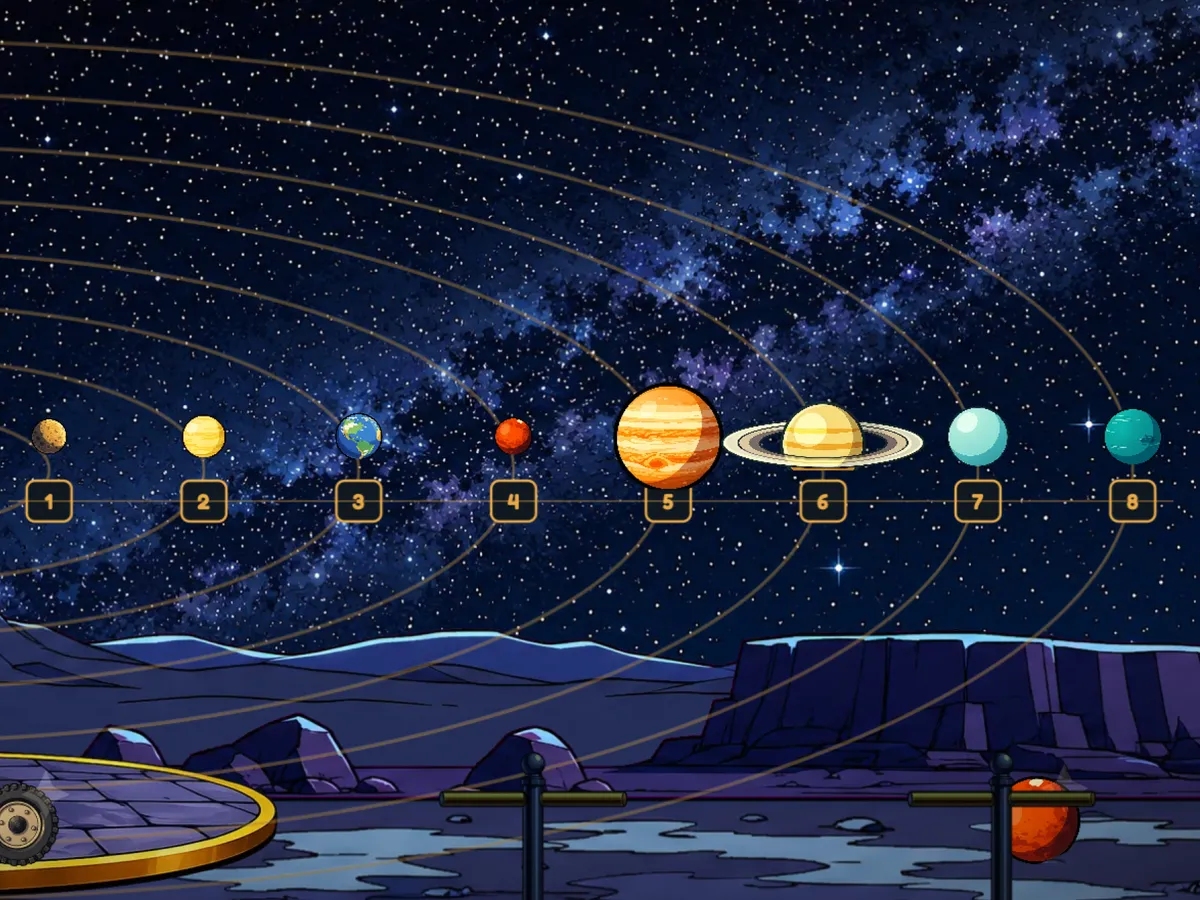
So astronomers build observatories on high, dry mountains, far from cities, where there is less air above them. The best spot of all is above the air completely. The Hubble Space Telescope has circled Earth since 1990, and the James Webb Space Telescope sees heat (infrared) from far beyond the Moon. Find out how they look at the planets of our solar system.
Terrific Telescope Facts
Some telescopes show the sky upside down.
Curved lenses and mirrors can flip the picture. Turning it the right way up would need extra glass, which loses some light, and in space up and down don’t matter much anyway.
Hubble needed glasses.
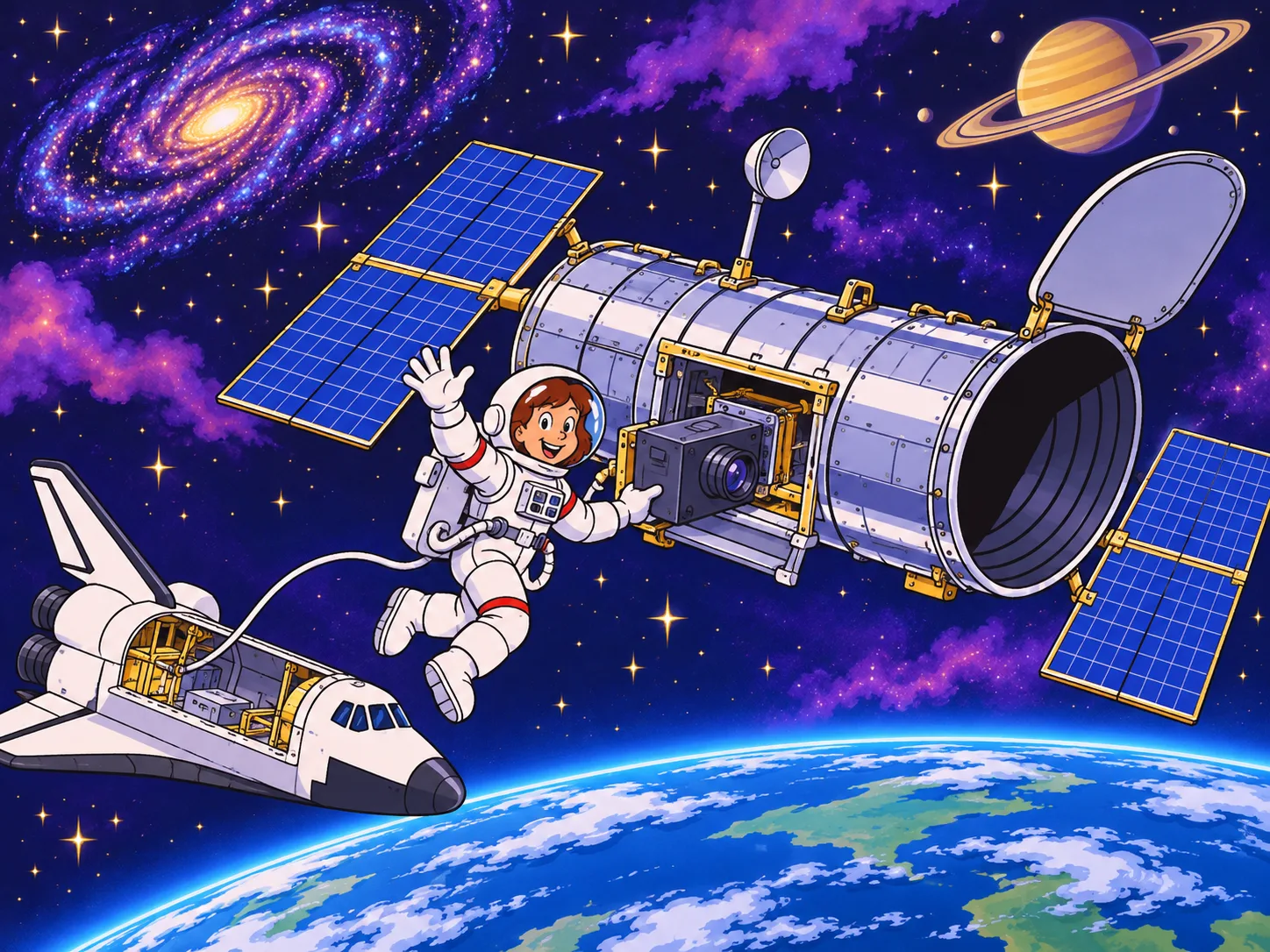
After launch in 1990, its mirror turned out to be the wrong shape, so its pictures were blurry. In 1993, astronauts added parts that fixed its view, like a pair of glasses.
Binoculars are two telescopes.
Binoculars are two small telescopes side by side, one for each eye.
The biggest mirror will have 798 pieces.
When it is finished, the Extremely Large Telescope’s 39-metre mirror will be built from 798 hexagons that work together as one.
Galileo found Jupiter’s four big moons.
They are still called the Galilean moons: Io, Europa, Ganymede and Callisto.
Science words to know
- Telescope
- A tool that collects light to help us see faraway things.
- Lens
- A curved piece of clear glass that bends light.
- Focus
- The point where a lens or mirror brings light together into a sharp picture.
- Eyepiece
- The small lens you look through, which makes the picture bigger.
- Observatory
- A building, often on a mountain, where scientists use big telescopes.
Quick quiz!
0 / 31. What does a telescope’s big lens or mirror do?
2. Why do all the giant telescopes use mirrors?
3. Why do astronomers put telescopes in space?
Questions kids ask
How does a telescope work in simple words?
A telescope uses a big curved lens or mirror to catch lots of light from a faraway object and bring it together into a small, bright picture. A small lens called an eyepiece then makes that picture bigger for your eye.
What is the difference between a refracting and a reflecting telescope?
A refracting telescope uses lenses to bend light. A reflecting telescope uses a curved mirror to bounce light. Big telescopes are reflecting telescopes, because big mirrors are easier to make and hold up than big lenses.
Who invented the telescope?
Spectacle makers in the Netherlands, around 1608. Hans Lipperhey was the first to ask for a patent. Galileo made his own telescopes in 1609 and used them to make famous discoveries about the sky.
How do space telescopes work?
Most work the same way, with big mirrors. Being above Earth’s air gives them a sharper view, and lets them see kinds of light the air blocks. Read about the most powerful one in the James Webb Space Telescope for kids.
The Infrared Eye
Look through the museum’s golden telescope and switch to infrared vision to find stars being born, hidden galaxies and Neptune’s secret rings.
No ads, ever · Plays offline · Made for young kids and adults