Who Invented the Light Bulb?
If you said Thomas Edison, you’re only partly right. The real story has more than twenty inventors, a race across the ocean, and a wire that glows white-hot.
So who really invented it?
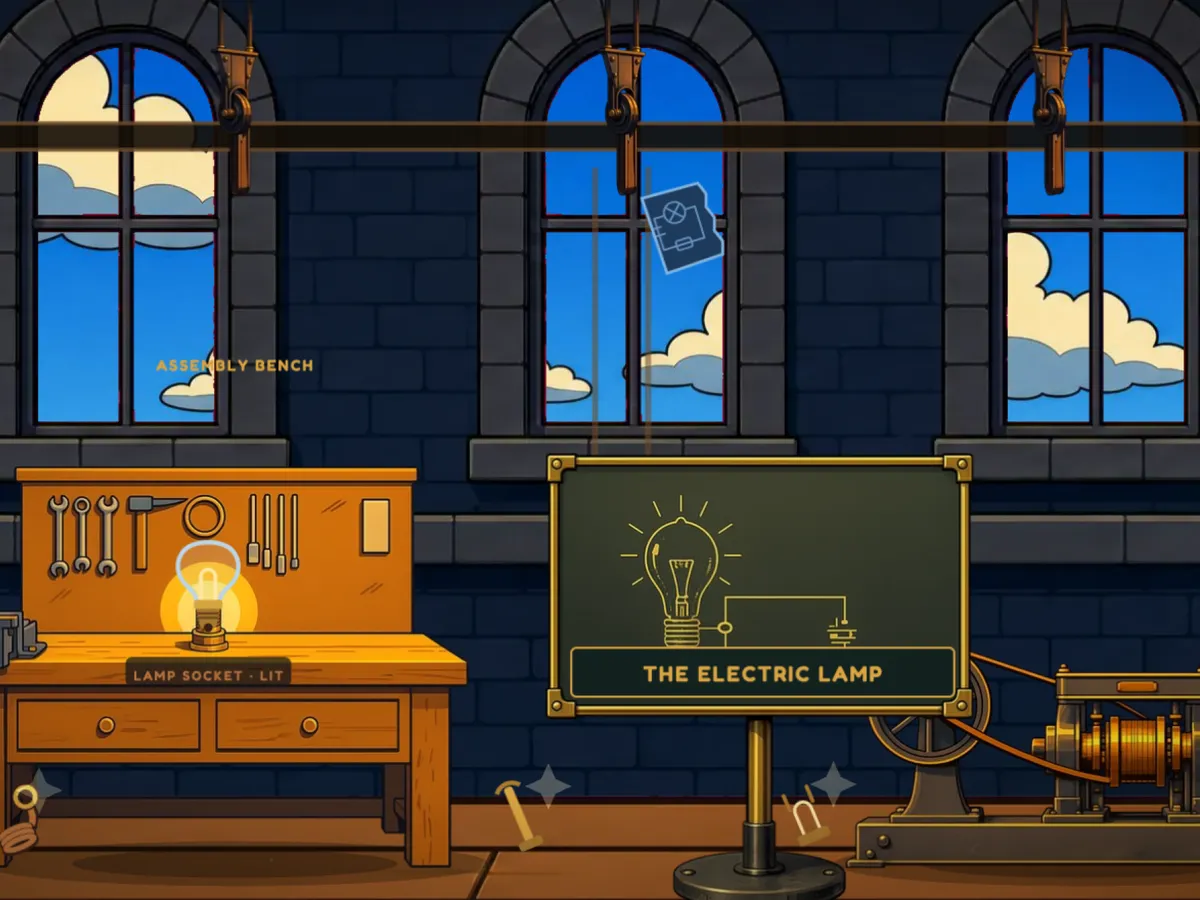
No single person invented the light bulb. More than twenty inventors built electric lamps before Thomas Edison did. In England, Joseph Swan was making bulbs at the same time as Edison, and his own house was one of the first in the world lit by electric light bulbs.
What Edison’s team in America added was a filament that lasted for hundreds of hours, and a whole system to go with it: power stations, wires under the streets, switches, sockets and meters. In 1883, Edison and Swan even joined forces and started a company together, nicknamed Ediswan.
How does a light bulb work?
An old-style light bulb, called an incandescent bulb, has a very thin wire inside called a filament. When electricity is pushed through it, the thin wire fights back so hard that it heats up until it glows white-hot. No flame, no smoke, just light.
But there’s a catch. A wire that hot would burn away in seconds in normal air. So the air is pumped out of the glass bulb, leaving a vacuum, and the filament can glow for hundreds of hours.
The race to make light
- 1
1800sSparks of light
Humphry Davy makes dazzling light with an electric spark jumping between two rods, called an arc light.
- 2
1831Electricity from magnets
Michael Faraday discovers that moving a magnet near a coil of wire makes electricity. That idea powers generators.
- 3
1840s–1870sLots of lamps
Inventors in many countries build glowing-wire lamps, but they burn out too fast or cost too much.
- 4
1878–1880Swan and Edison
Joseph Swan in England and Thomas Edison’s team in America both make bulbs that work well.
- 5
1882Lights on in the city
Edison’s power station in New York starts sending electricity to homes and offices.
- 6
TodayLED lights
Modern LED bulbs make light without a hot filament, and use much less electricity.
A lamp needs a generator
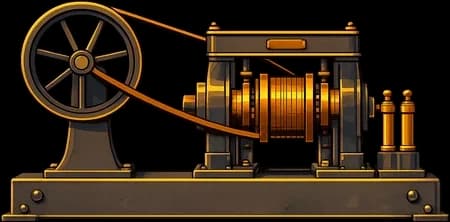
A light bulb is no use without electricity to power it. A generator turns movement into electricity by spinning a coil of wire near magnets, just as Faraday discovered.
Nearly every light in the world still gets its power this way, from generators spun by steam, wind or falling water. Find out how electricity flows in how do circuits work.
Bright Ideas
A London theatre was one of the first buildings lit by electric bulbs.
The Savoy Theatre lit its stage and seats with Joseph Swan’s bulbs in 1881.
A fuse breaks on purpose.
A fuse is a thin wire that melts if too much electricity flows, so nothing more important gets damaged.
Old bulbs made more heat than light.
Most of the energy in an incandescent bulb turns into heat. That’s why LEDs, which stay cool, save so much energy.
Magnets make electricity.
Spin a coil of wire near a magnet, and electricity flows in the wire. That’s how power stations work.
Great inventions are usually team efforts.
Edison worked with a large team of engineers and scientists in his lab at Menlo Park, New Jersey.
Science words to know
- Filament
- The thin wire inside an old light bulb that glows when electricity flows.
- Vacuum
- A space with the air taken out.
- Generator
- A machine that turns movement into electricity.
- Fuse
- A safety wire that melts first if too much electricity flows.
Quick quiz!
0 / 31. Who invented the light bulb?
2. Why is the air pumped out of a light bulb?
3. What did Michael Faraday discover in 1831?
Questions kids ask
Did Thomas Edison invent the light bulb?
Not on his own. Many inventors built lamps before him. Edison’s team made a long-lasting bulb and the whole electric system to power it.
When was the light bulb invented?
Electric lamps were built throughout the 1800s. Practical, long-lasting bulbs arrived around 1879 and 1880, from Joseph Swan in England and Thomas Edison in America.
How does a light bulb work?
Electricity flows through a thin filament, heating it until it glows. The air is removed so the filament doesn’t burn away.
What powers a light bulb?
Electricity, usually made by generators in power stations and carried through wires. See how do circuits work.
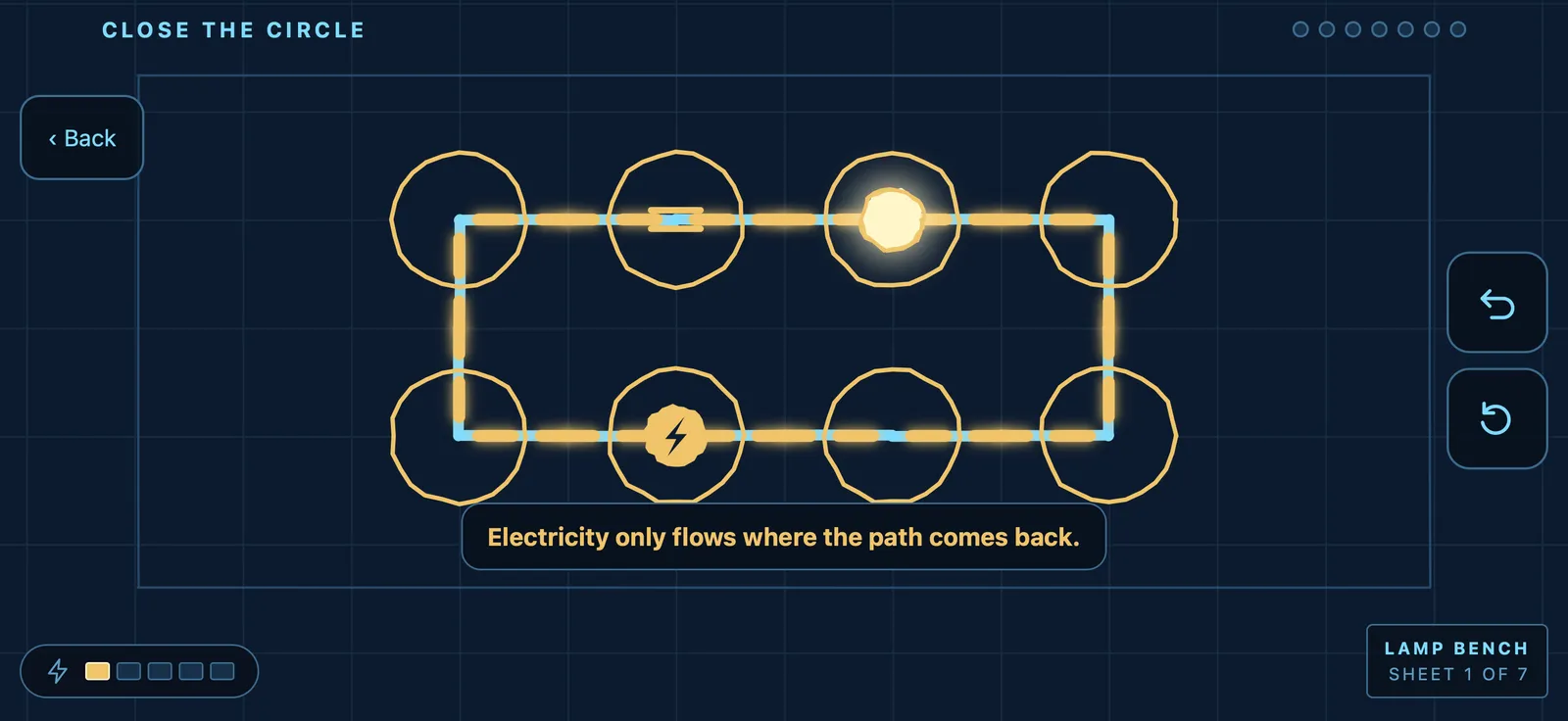
The Schematic
Connect the wires and close the circle! Light every lamp in the workshop by making a complete path for the electricity.
No ads, ever · Plays offline · Made for young kids and adults